旌
Character Story & Explanation
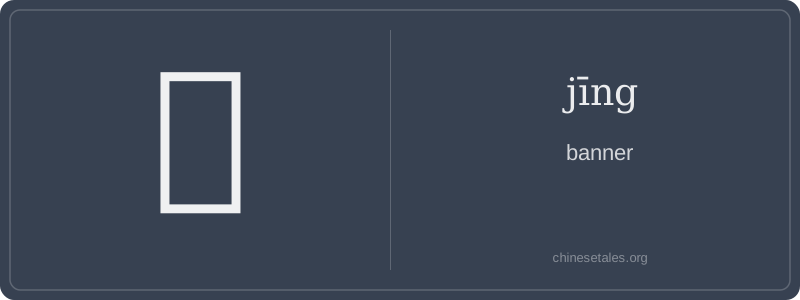
The earliest form of 旌 appears on Warring States bamboo slips and Han dynasty seals—not as a pictograph, but as a logical composite. Its left side 方 (fāng) represents the ‘square-shaped standard pole’ used to mount banners upright and visibly. The right side 生 (shēng), originally depicting sprouting plants, was borrowed here for its sound (jīng shares phonetic lineage with 生 in ancient dialects), but also subtly conveys ‘vitality’ and ‘presence’—a banner must stand tall and alive to inspire. Over centuries, the top stroke of 生 simplified, and the lower part evolved from three horizontal lines () into today’s 丿 + 一 + 丨 structure—11 strokes total, balanced and upright like the pole itself.
This character didn’t just describe cloth on a stick—it embodied *command made visible*. In the Zuo Zhuan, ‘旌以令众’ (‘Raise the 旌 to command the masses’) shows how it functioned as both tool and symbol of legitimate leadership. Its visual symmetry—square base, vertical pole, flowing ‘banner’ element—mirrors Confucian ideals: grounded in principle (方), upright in conduct (the central stroke), and expressive in virtue (the ‘life’-infused right side). Even today, when writers choose 旌 over 旗, they’re invoking that layered resonance of moral clarity and public authority.
At its heart, 旌 (jīng) isn’t just any banner—it’s a *ceremonial*, *authoritative* banner: think ancient generals raising silk standards before battle, or imperial envoys bearing royal insignia. It evokes dignity, legitimacy, and visible command—not the casual ‘flag’ of modern nationalism (that’s 旗 qí), nor the generic ‘banner’ of digital ads (横幅 héngfú). To Chinese speakers, 旌 carries literary weight; you’ll find it in classical poetry and historical texts, rarely in daily speech. Its presence instantly elevates tone—like dropping ‘heraldic’ instead of ‘flag’ in English.
Grammatically, 旌 functions almost exclusively as a noun, often embedded in formal or literary compounds (e.g., 旌旗 jīngqí ‘banners and flags’). You won’t say ‘I waved a 旌’—it doesn’t take measure words like 张 or 面. Instead, it appears in set phrases or as a subject/object in elevated syntax: ‘旌立于城楼’ (A banner stands atop the city tower). Learners sometimes mistakenly use it for national flags or protest banners—both culturally off-key and linguistically unnatural.
Culturally, 旌 reflects China’s deep-rooted association between visual symbols and moral-political authority. In the Analects and Records of the Grand Historian, raising a 旌 signaled righteous cause or divine mandate—not mere identification. A common error is overgeneralizing it to mean ‘sign’ or ‘symbol’ broadly; that’s more 符 fú or 标志 biāozhì. Also, watch the radical: 方 (fāng, ‘square’, ‘direction’) hints at its original function—orienting troops, marking territory, projecting order into chaos.