斄
Character Story & Explanation
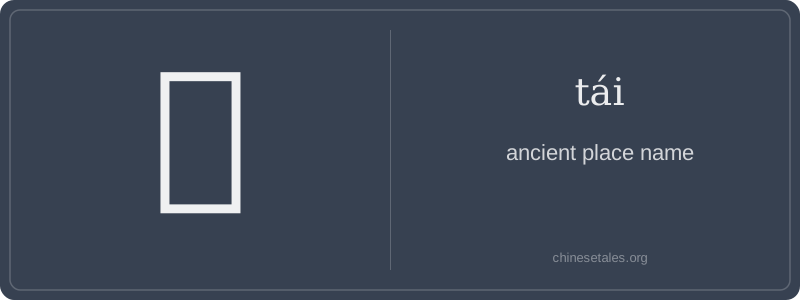
The earliest attested form of 斄 appears on Warring States bamboo slips — not oracle bones — where it’s written with a left-side ‘邑’ (yì, ‘settlement’, later simplified to 阝 as right-side radical) and right-side ‘來’ (lái, ‘to come’). The ‘邑’ component signals this is a place name; the ‘來’ was likely phonetic, approximating the local pronunciation *tái*. Over centuries, the left ‘邑’ migrated to the right (standard for place-name characters), and the ‘來’ subtly stylized: its top ‘two wheat stalks’ became two short horizontal strokes, and its lower ‘crossed legs’ condensed into a compact ‘人’-like base — yielding today’s 斄.
This character never evolved semantically — it didn’t branch into verbs or metaphors like many ancient characters did. It remained stubbornly geographical, tied to the State of Qi’s eastern frontier. Sima Qian mentions ‘Dōnglái’ (Eastern Lai) in the Shiji, referring to the region around 斄, which was absorbed after Qi conquered the Lai state circa 567 BCE. Visually, the ‘來’ in 斄 doesn’t mean ‘coming’ — it’s pure sound mimicry. So while the shape whispers ‘arriving at a town’, the truth is quieter: it’s just how scribes spelled a name they heard — a phonetic fossil frozen in time.
Let’s get real: 斄 (tái) is a linguistic fossil — not a word you’ll hear in daily chat, order dumplings with, or see on subway ads. It exists almost exclusively as an ancient place name from the Warring States period, tucked away in classical texts like the Zuo Zhuan and Shiji. Its ‘meaning’ isn’t conceptual like ‘love’ or ‘river’ — it’s purely toponymic: a proper noun anchor for a vanished settlement near modern-day Shandong. Think of it less as a ‘word’ and more as a historical GPS coordinate carved in ink.
Grammatically, 斄 functions only as a rigid proper noun — never as a verb, adjective, or standalone noun. You’ll never say ‘I 斄’d yesterday’ or ‘a very 斄 atmosphere’. It appears solely in fixed, archaic contexts: ‘Xīn 斄’ (Xinlai), ‘Dōng 斄’ (Donglai), always paired with directional or administrative modifiers. Learners sometimes mistakenly treat it like a common noun and try to pluralize or modify it — but nope. It’s grammatically inert, like ‘Athens’ or ‘Carthage’ in English: you refer *to* it, never *with* it.
Culturally, 斄 is a quiet reminder that Chinese writing preserves layers of history most speakers never consciously access. Its rarity means even native scholars pause at it — it’s not in dictionaries like Xinhua or used in modern maps. Mistake-wise: don’t confuse its pronunciation (tái, second tone) with tái (‘moss’) or tái (‘platform’) — same pinyin, zero semantic overlap. And yes, its stroke count is *not* zero — that’s a trick in your prompt! It has 12 strokes. But its functional absence from modern life? That’s very real.