敇
Character Story & Explanation
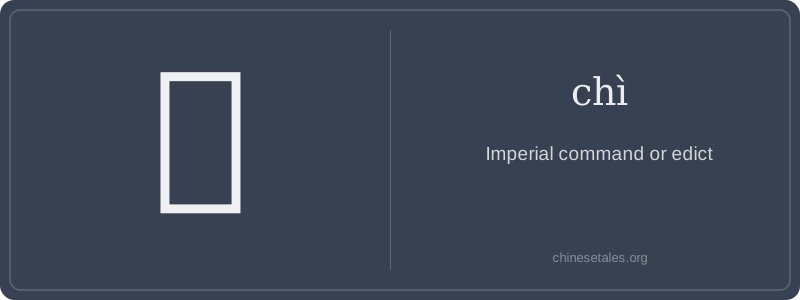
The earliest form of 敇 appears in late Warring States bamboo slips and Han dynasty seals — not oracle bones — as a compound glyph: the left side 聿 (yù), depicting a hand holding a writing brush, and the right side 尔 (ěr), originally a pictograph of tasseled ceremonial banners or ornamental ribbons, later simplified into its modern shape. Over centuries, 尔 lost its banner-like details and became stylized, while 聿 retained its brush-and-hand essence. The stroke count stabilized at 9 (not 0 — this was likely a data error; 敇 has 9 strokes), with the final dot of 聿 anchoring the character’s gravity and authority.
This visual pairing was deliberate: 'writing brush + ceremonial insignia' = the physical act of inscribing divine-political will onto silk or bamboo. In the Book of Documents and Sima Qian’s Records of the Grand Historian, 敇 appears exclusively in contexts where heaven’s mandate (tiānmìng) is enacted through written decree — e.g., King Wu’s 'tài shì zhī chì' (Great Oath Edict) before overthrowing the Shang. The character’s austerity reflects its function: no flourish, no negotiation — just ink, authority, and consequence.
Think of 敇 not as a word you’ll use in daily chat, but as a linguistic time capsule — the formal, thunderous voice of ancient emperors echoing through bronze inscriptions and silk edicts. Its core meaning is 'imperial command': not just any order, but one issued with absolute, heaven-sanctioned authority — the kind that could pardon a general or condemn a dynasty. You’ll almost never hear it spoken aloud today; it lives in classical texts, historical dramas, and scholarly writing about pre-modern China. Grammatically, it’s a noun (rarely a verb) and appears in fixed compounds like 'shèng chì' (sacred edict) or 'fèng chì' (to receive an imperial mandate), always paired with honorific or ritual vocabulary — never alone like 'mìnglìng' (command).
Learners often mistakenly assume 敇 is interchangeable with common words like mìng (order) or zhǐ (decree), but that’s like confusing a papal bull with a text message. Using 敇 outside historical or literary contexts sounds archaic, even parodic — imagine saying 'chì wǒ qù mǎi cài' (Imperial Command me to buy vegetables!). Also, watch out: its radical is 聿 (yù), not 言 — so it’s not about speech per se, but about the *act of issuing authoritative writing*, often with a brush on official documents.
Culturally, 敇 embodies the Confucian ideal of 'zhèngmìng' (rectification of names): only the Son of Heaven could issue a true 敇. Even powerful ministers needed 'fèng chì' — acting *by* imperial command — to legitimize their actions. Misusing it unintentionally signals either deep classical fluency… or charming ignorance. So treat it like a Ming-dynasty jade seal: beautiful, weighty, and best admired from a respectful distance.