攴
Character Story & Explanation
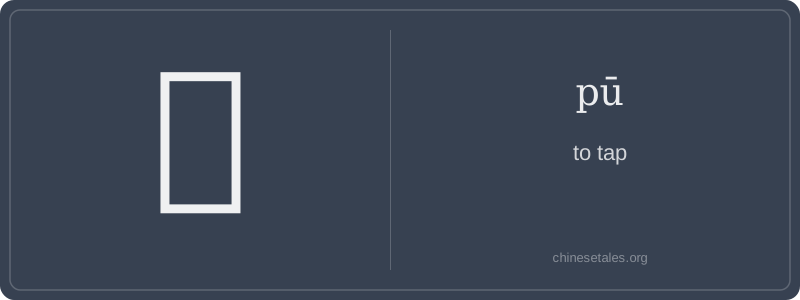
The earliest form of 攴 appears in oracle bone inscriptions as a hand holding a short, curved stick (often stylized as a bent line), striking downward—sometimes even depicted mid-motion, with a small dot representing impact. Over centuries, the hand simplified into the left component (a variant of 又), and the stick evolved into the three rightward strokes (丿、丶、乀), forming today’s compact, angular shape: a hand + a deliberate downward stroke + two follow-through flicks—like the crisp rebound after tapping wood.
This pictograph’s meaning stayed remarkably stable: from Shang dynasty divination records (where it denoted ritual striking of ceremonial objects) to the *Shuōwén Jiězì* (121 CE), which defines it as ‘to strike lightly, to correct’. In the *Analects*, Confucius uses related terms like 政 (governance) and 教 (teaching)—both bearing 攴—to imply that leadership and education begin not with decree, but with calibrated, timely intervention—like that tutor’s tap: brief, clear, and full of consequence.
Imagine a stern but kind Confucian tutor in the Han dynasty, gently tapping a bamboo ruler on his palm—not to punish, but to punctuate a student’s recitation: *tap*, pause; *tap*, breathe; *tap*, reflect. That soft, rhythmic, intentional strike is exactly what 攴 (pū) embodies—not violence, not force, but precise, purposeful, pedagogical tapping. It’s the sound of correction, encouragement, or gentle insistence—always controlled, always meaningful.
Grammatically, 攴 rarely stands alone in modern Mandarin—it’s almost exclusively a radical (appearing in characters like 教, 政, 攻, 散), where it infuses meaning related to action, influence, or intervention. You’ll never say ‘I pū the door’—but you *will* encounter it silently shaping words like ‘to teach’ (教) or ‘to govern’ (政). Learners often mistakenly treat it as a standalone verb or confuse it with similar-looking radicals—but no: 攴 is a semantic seed, not a fruit.
Culturally, this character carries the quiet authority of ritualized action—the tap that signals transition, the nudge that initiates change. A common mistake is over-literal translation: ‘to tap’ sounds trivial, but in classical compounds, 攴 implies authoritative initiation—like striking a bell to open court or tapping a drum to begin ceremony. Its power lies in restraint: four strokes, no flourish, all intention.