攥
Character Story & Explanation
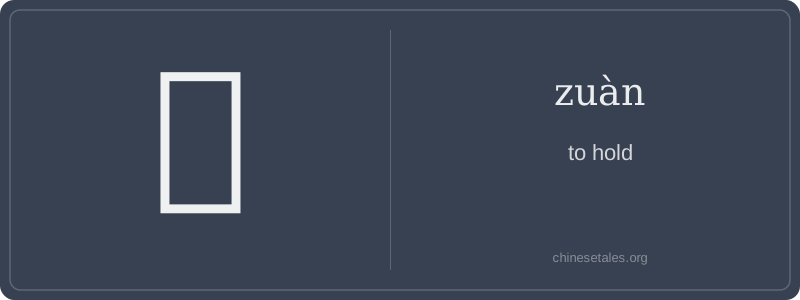
The earliest form of 攥 appears in late Warring States bamboo texts as a complex pictograph: a hand radical on the left, and on the right, a stylized depiction of a closed fist with three prominent knuckles and bent fingers — not abstract lines, but a literal anatomical sketch of grip. Over centuries, the right side evolved from bone-script ‘fist + rope’ (suggesting binding/holding fast) into the modern 爨 (cuàn), which originally meant 'cooking fire' but was borrowed here purely for sound. The 23 strokes crystallized during the Han dynasty seal script, where scribes exaggerated the coiling motion of fingers wrapping inward — each stroke tracing muscle strain.
This visual logic anchored its semantic journey: from concrete 'clenching a tool' in agricultural manuals (e.g.,《齐民要术》mentions farmers 攥锄柄 'gripping the hoe handle') to metaphorical uses by Tang poets like Du Fu, who wrote of hearts 攥着 sorrow — a visceral image of emotional containment. Even today, the character’s density and downward-tapering shape echo the physical sensation of tightening — no wonder classical writers chose it when describing resolve hardening like cooled iron.
At its heart, 攥 (zuàn) is the visceral, physical act of gripping something tightly with your fist — not just holding, but clenching, squeezing, and securing. Think knuckles whitening around a lucky coin or a child’s tiny fist wrapped around a parent’s finger. It’s emphatically *manual*: the left-hand radical 扌 (hand) telegraphs that this is about deliberate, muscular action, not passive possession like 有 (yǒu) or abstract control like 掌 (zhǎng). Unlike generic verbs like 拿 (ná, 'to take/handle'), 攥 implies tension, intention, and often emotional weight — anxiety, determination, or protectiveness.
Grammatically, it’s a transitive verb requiring a direct object: you 攥 something — never *in* something or *with* something. It frequently appears in descriptive narrative ('she 攥着 the letter until her fingers trembled') or dialogue tags ('he said, 攥紧拳头'). Learners often mistakenly use it where 捏 (niē, 'to pinch/twist gently') or 抓 (zhuā, 'to grab/clutch') would fit better — but 攥 is uniquely about *fist-closing*, not fingering or snatching. Also beware: it’s almost never used in formal writing or bureaucratic contexts; it lives in novels, poetry, and spoken emotion.
Culturally, 攥 carries warmth and vulnerability — a grandfather 攥着 his grandchild’s hand across a busy street isn’t just holding; he’s anchoring, shielding, and connecting. Misusing it (e.g., saying 攥钱 for 'to save money') sounds jarringly physical and unidiomatic — savings are stored, not clenched. And yes, that 23-stroke complexity? It’s not arbitrary — every curve and hook mirrors the contortion of tendons and knuckles under pressure.