撷
Character Story & Explanation
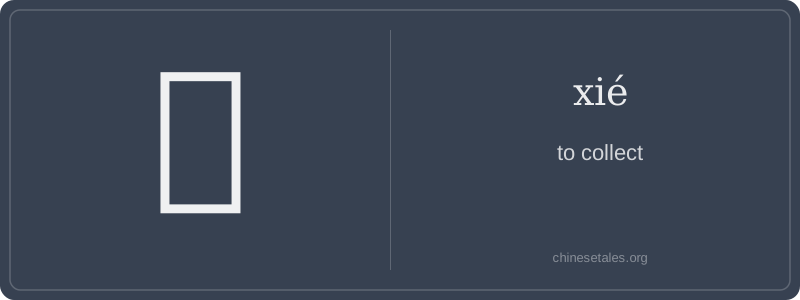
The earliest form of 撷 appears in seal script as a combination of 扌 (hand radical) and 協 (a phonetic component meaning ‘harmony’, later simplified to 皆). But look closer: the right side originally contained 口 (mouth) + 十 (ten), suggesting coordinated action — hands working *in concert* to select. Over centuries, the top part evolved from 口+十 into 皆 (jiē), while the hand radical stabilized as 扌. The 15 strokes encode precision: three horizontal strokes on the left (the hand’s fingers poised), then the balanced, layered structure of 皆 — hinting at discernment, not brute force.
This character first bloomed in classical texts like the *Wen Xuan* (Selections of Refined Literature), where editors ‘plucked’ (撷) choice passages from thousands of poems. Its meaning never strayed far from *selective gathering*: not harvesting grain, but curating beauty. Even today, when scholars ‘excerpt’ (撷取) key ideas from Confucian commentaries, they echo that same ritual of mindful selection — as if each word were a rare orchid, chosen only after quiet observation.
At its heart, 撷 (xié) is not just 'to collect' — it’s *to gather with care*, like plucking the finest blossoms from a branch or selecting rare phrases from ancient poetry. It carries elegance and intentionality: you don’t just grab; you choose deliberately, often for preservation or artistic use. Think of a scholar in a quiet garden, fingertips brushing a dewy plum blossom — that’s the feeling embedded in this character.
Grammatically, 撷 is almost always transitive and formal — it rarely appears in casual speech or beginner texts. You’ll find it in literary contexts, academic writing, or set phrases like 撷取精华 (‘extract the essence’). It never stands alone as a verb in daily conversation (you wouldn’t say ‘I 撷 some apples’); instead, it pairs with abstract nouns: knowledge, wisdom, metaphors, poetic lines. Learners sometimes mistakenly use it like 拿 or 收, but that sounds jarringly archaic — like saying ‘I doth gather thy apples’ at the grocery store.
Culturally, 撷 evokes classical Chinese aesthetics: the refined act of curation. In Tang poetry anthologies, editors ‘plucked’ (撷) only the most luminous verses. A common mistake is overusing it in spoken Mandarin — it’s a brushstroke, not a highlighter. Also, watch the tone: xié (second tone), *not* xī or xiě — mispronouncing it risks sounding like ‘to thank’ (谢) or ‘to write’ (写), which creates delightful but disastrous confusion.