擭
Character Story & Explanation
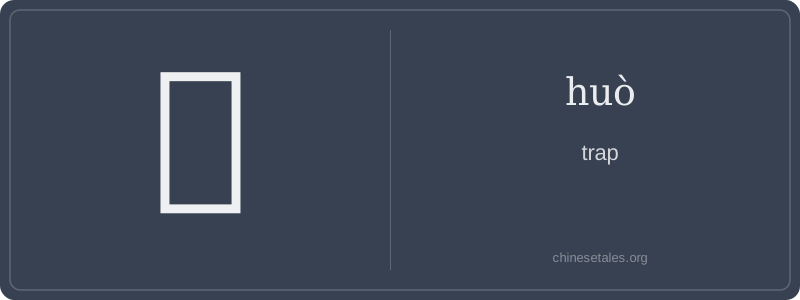
The earliest form of 擭 appears in Warring States bamboo slips — not oracle bones, but close! It combined 扌 (hand radical, indicating action or manipulation) with 霍 (huò), a phonetic component that originally depicted rain falling on grass (radical 雨 + 豕), later repurposed for sound. The hand + ‘huò’ combo visually suggested *a hand triggering something sudden and sweeping* — like rain descending, or a trap snapping. Over centuries, the left side standardized as 扌, while the right evolved from a complex rain-and-pig glyph into today’s streamlined 霍, losing its pictographic clarity but gaining phonetic reliability.
This evolution mirrors its semantic journey: from concrete mechanical device (a spring-loaded pitfall in military manuals) to abstract, morally charged entrapment. In the Book of Rites (Lǐjì), 擭 appears in contexts warning rulers against ‘setting traps for the people’ — metaphorically, enacting unjust laws. By the Tang dynasty, poets used it allusively: ‘The mountain path hides a hundred 擭’ — not literal snares, but treacherous turns of fate. The hand radical reminds us: every 擭 requires human intention. It’s never accidental — always *laid*.
Let’s be honest: 擭 (huò) is a rare, almost theatrical character — it doesn’t whisper ‘trap’; it *snaps* shut like a bear trap in a Ming dynasty scroll. Its core feeling isn’t just ‘device that catches’, but ‘deliberate, concealed entrapment’ — often with moral or strategic weight. You’ll rarely hear it in daily speech (no one says ‘I set up a 擭 in my backyard’), but you’ll see it in classical idioms, historical novels, or formal writing about deception, ambushes, or legal snares.
Grammatically, 擭 functions almost exclusively as a noun — never a verb (unlike 设陷阱 shè xiànjǐng, which *means* ‘to set a trap’). It appears in compound nouns (e.g., 机关擭 jīguān huò), and sometimes as the object of verbs like 布置 (bùzhì, ‘to arrange’) or 中 (zhòng, ‘to fall into’). A classic mistake? Trying to use it like a verb — ‘He 擭ed the spy’ — nope! That’s not how Chinese works. Also, don’t confuse it with simpler synonyms: 擭 carries literary gravity, while 陷阱 (xiànjǐng) is neutral and common.
Culturally, 擭 evokes ancient warfare and cunning — think Sun Tzu warning against ‘the trap of false retreat’. It’s the kind of word used when describing how a corrupt official was *lured into a 擭* by evidence he thought was safe. Learners often overestimate its frequency; it’s more ‘Shakespearean prop’ than ‘kitchen utensil’. If you master it, you’re not just learning vocabulary — you’re unlocking a rhetorical weapon from China’s literary arsenal.