擐
Character Story & Explanation
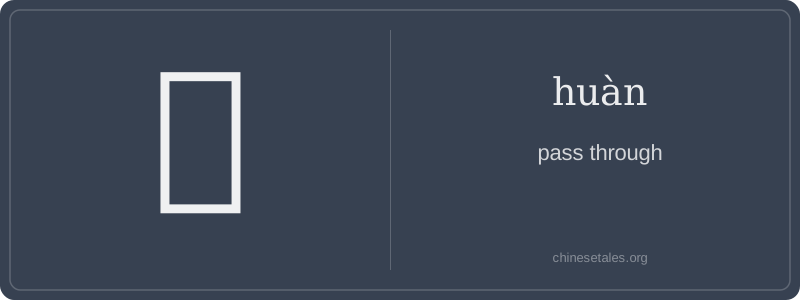
The earliest form of 擐 appears in bronze inscriptions of the late Zhou dynasty — not as a pictograph, but as a compound ideograph. Its left side 扌 (hand radical) was already standardized, representing action; the right side 幵 (jiān), now obsolete as an independent character, originally depicted two parallel gates or barriers — suggesting a channel or passage. Over centuries, 幵 evolved into the modern component 串 (chuàn, 'to string together'), but in 擐, it retained its ancient sense of 'dual apertures aligned'. The full character thus visually spells out 'hand guiding something *through* aligned openings' — a brilliant stroke-by-stroke encoding of directed passage.
This precise visual logic shaped its classical usage: in the Zuo Zhuan, warriors are described 擐甲 (huàn jiǎ) — 'threading armor plates onto their bodies' — emphasizing the careful, sequential act of donning layered lamellar armor. Later, in Tang poetry, 擐 appears in lines like '擐玉簪于云鬓' ('threading a jade hairpin into cloud-like tresses'), where the verb evokes both physical dexterity and aesthetic reverence. Even today, its shape — 16 strokes forming a tight, vertical flow — mirrors its meaning: no wasted motion, no deviation from the path.
Think of 擐 (huàn) as the Chinese equivalent of the English verb 'to thread' — not just physically, but with intention, precision, and a hint of ceremony. It doesn’t mean casual insertion (like shoving a key in a lock), but rather *guiding something deliberately through an opening or aperture*: a sleeve over an arm, a jade ring onto a finger, a sword into its scabbard. Its core feeling is controlled passage — like threading a needle while wearing gloves at a Ming dynasty banquet.
Grammatically, 擐 is almost exclusively a transitive verb and appears most often in classical or literary contexts, rarely in spoken Mandarin. It’s typically followed by a noun object and often paired with directional complements or locative phrases: 擐入 (huàn rù, 'thread into'), 擐上 (huàn shàng, 'thread onto'). You’ll almost never hear it in daily conversation — instead, you’ll find it in historical novels, poetry, or formal descriptions of ritual dress: 'He 擐 his ceremonial robe' sounds stilted in English, but that’s exactly how it feels in Chinese — elegant, deliberate, slightly archaic.
Learners often misread it as a synonym for 穿 (chuān, 'to wear'), but that’s a classic trap: 穿 is general-purpose ('wear clothes', 'pierce through'), while 擐 implies *directional motion along a narrow path* — think of a river flowing *through* a gorge, not just being *in* it. Also, avoid confusing it with 換 (huàn, 'to exchange') — same pinyin, totally unrelated meaning and radical. If you use 擐 when you mean 穿, your sentence won’t be wrong grammatically, but it will sound like quoting a Tang dynasty envoy at a coffee shop.