擂
Character Story & Explanation
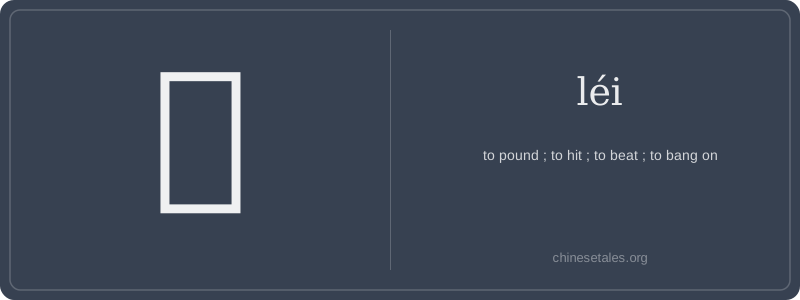
The earliest forms (late Shang oracle bones and Zhou bronzes) show a hand holding a long, tapered tool — likely a pestle — poised over a rounded container, possibly a mortar. Over centuries, the container simplified into the '畾' component (three stacked '田'-like shapes), visually echoing repetition and resonance — like thunder rolling across hills. The left-hand radical stabilized early as 扌 (hand), while the right evolved from pictographic mortar+pestle into the stylized '畾', which itself derives from '雷' (thunder), reinforcing the booming, reverberating quality of the action.
This visual logic deepened in classical usage: in the Records of the Grand Historian, generals are described 擂鼓以振士气 — 'pounding drums to rouse troop morale', linking physical force to psychological impact. By the Song dynasty, 擂 had expanded beyond literal pounding to metaphorical 'challenging' — as in mounting a platform (擂台) to invite combat, where each step up was itself an act of defiant, resonant assertion. The character thus fused material labor, sonic power, and performative courage — all encoded in its 16 strokes.
Imagine a hand (the 扌 radical) gripping something heavy — not a sword or brush, but a thick wooden pestle. That’s the visceral core of 擂: it’s not gentle tapping or light knocking; it’s rhythmic, forceful pounding — like crushing garlic in a mortar, beating a war drum before battle, or slamming fists on a table to demand attention. The character pulses with physical energy and intentionality: you *choose* to 擂 — it’s never accidental.
Grammatically, 擂 is almost always a verb, often transitive (requiring an object), and commonly appears in vivid, action-driven contexts: 擂鼓 (beat the drum), 擂蒜 (pound garlic), or even figuratively as in 擂台 (a contest platform, literally 'pounding stage'). Learners sometimes mistakenly use it for generic 'hitting' — but that’s 打. 擂 implies sustained, repetitive, resonant impact — think 'thump-thump-thump', not 'whack'. You wouldn’t 擂 a doorbell; you’d 按 it. But you *would* 擂 the gong to open a ceremony.
Culturally, 擂 carries echoes of ancient ritual and martial tradition — from battlefield drums to village medicine preparation. A subtle trap: the lèi pronunciation (as in 擂台) is a specialized literary reading tied to the 'contest platform' meaning, while léi dominates everyday verbs. Don’t force lèi into 'pounding garlic' — that’s always léi. Also, note the right side isn’t '雷' (thunder) by accident: the thunderous sound *is* the point — this character doesn’t just describe motion, it evokes vibration in your bones.