挝
Character Story & Explanation
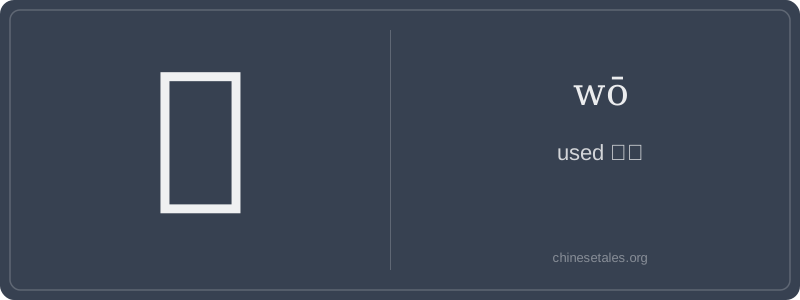
The earliest form of 挝 appears in late clerical script (around Han dynasty), evolving from 手 (hand) + 過 (guò, 'to pass'). Its oracle bone roots are lost — it’s a relatively late creation, designed not as a pictograph but as a phono-semantic compound: the left-hand 'hand' radical (扌) hints at physical action, while the right side 過 provides the core pronunciation (guò → wō via dialectal shift and tonal simplification). Visually, it’s elegant: three strokes for the hand radical, then six more forming the 'passing' component — a balanced 9-stroke dance of motion and transition.
Originally, 挝 did carry the rare, literary meaning 'to tap lightly' or 'to brush past', seen in a few Ming-Qing regional texts describing delicate gestures — like tapping a gong before prayer or brushing aside bamboo curtains. But by the early 20th century, that usage faded entirely, preserved only in the transliteration of 'Laos' (from French 'Laos', pronounced /laɔs/ → approximated as Lǎo Wō). Its visual 'hand + passing' structure ironically mirrors Laos’ geographic identity: a land 'passed through' by rivers and trade routes, gently touched by neighboring cultures — a quiet resonance no dictionary mentions.
Let’s cut through the confusion first: 挝 (wō) isn’t a standalone verb you’ll use in daily conversation — it’s almost exclusively found in the proper noun 老挝 (Lǎo Wō), the Chinese name for Laos. Think of it as a linguistic fossil: its meaning is frozen in place, not active in modern grammar. The character itself feels like a gentle, rhythmic gesture — not forceful like 打 (dǎ, 'to hit') or sharp like 刺 (cì, 'to stab') — and that softness matches the tone of the country’s name in Chinese, which aims for phonetic approximation rather than semantic weight.
Grammatically, 挝 appears only in fixed compounds, never as a free verb. You won’t say 'I 挝 the door' — that would be nonsensical and instantly flagged by native speakers. Its sole functional role is as the second syllable in 老挝, always pronounced wō (never wā or wǒ). Learners sometimes misread it as wā (like in 哇!) or confuse it with 涡 (wō, 'whirlpool'), but this character has zero connection to water or sound effects — it’s purely phonographic here. Even native speakers rarely pause to think about its shape; they treat it as a unitary sound-symbol.
Culturally, this is a beautiful example of how Chinese handles foreign names: choosing characters that *sound right*, even if their individual meanings ('to strike gently' or 'to tap') are irrelevant. That’s why the 'hand' radical (扌) remains — a historical echo of its original meaning, now silent. A common mistake? Trying to parse 挝 semantically. Don’t! Treat it like the letter 'x' in 'xylophone' — it’s there for sound, not sense.