挞
Character Story & Explanation
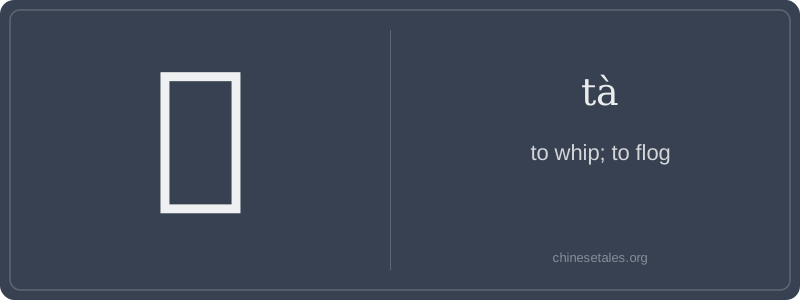
The earliest form of 挞 appears in bronze inscriptions as a hand (扌) gripping a flexible, segmented object—likely a whip or rattan rod—depicted with wavy lines suggesting motion and suppleness. Over time, the ‘whip’ element simplified into the right-hand component 达 (dá), which originally meant ‘to reach’ or ‘to penetrate’ (hinting at the whip’s stinging reach). By the Han dynasty, the structure solidified: left side 扌 (hand radical) anchoring action, right side 达 conveying both sound (tà) and semantic force—‘to strike so decisively it reaches the core of the offense’.
This visual logic shaped its meaning: not mere hitting, but *penetrating correction*. Confucian texts like the Book of Rites (Liji) use 挞 to describe ceremonial floggings intended to ‘awaken virtue’—punishment as pedagogy. Later, in military classics, 挞 evolved into metaphorical usage: 挞伐 (tàfá) meant ‘to attack and subdue’, merging physical force with moral justification. Even today, the shape whispers its origin: nine strokes—one for each crack of the whip, perhaps—yet every line remains precise, controlled, and unmistakably authoritative.
Imagine a stern Tang dynasty magistrate slamming his palm on the lacquered desk—not to shout, but to signal the executioner behind the screen. The character 挞 (tà) isn’t just ‘to whip’—it’s the sharp, ritualized *crack* of authority made physical: a deliberate, official act of corporal punishment, often administered with a leather strap or bamboo rod. In classical Chinese, it carries gravity and formality; you’d never use it for casually swatting a fly or scolding a child. It’s reserved for discipline with legal or moral weight—think ‘punish by flogging’, not ‘spank’.
Grammatically, 挞 is almost always transitive and appears in formal or literary contexts: as a verb (e.g., 挞伐 tàfá, ‘to condemn and punish’), or in compound verbs like 挞笞 (tàchī). It rarely stands alone in modern speech—it’s a ‘high-register’ word, like using ‘scourge’ instead of ‘whip’ in English. Learners sometimes misapply it as a general synonym for 打 (dǎ, ‘to hit’), but that’s like calling a judge’s gavel ‘a stick’—technically true, but missing all the institutional heft.
Culturally, 挞 echoes ancient rites of justice: the Zhou Li (Rites of Zhou) prescribes 挞 as one of five punishments, applied only after investigation and confession. Today, it survives mostly in idioms and historical discourse—not daily conversation—but its presence signals moral severity. A common mistake? Confusing it with 踏 (tà, ‘to step on’) due to identical pinyin and similar stroke count—yet their radicals (扌 vs. 足) and meanings are worlds apart: one strikes with the hand, the other presses with the foot.