撰
Character Story & Explanation
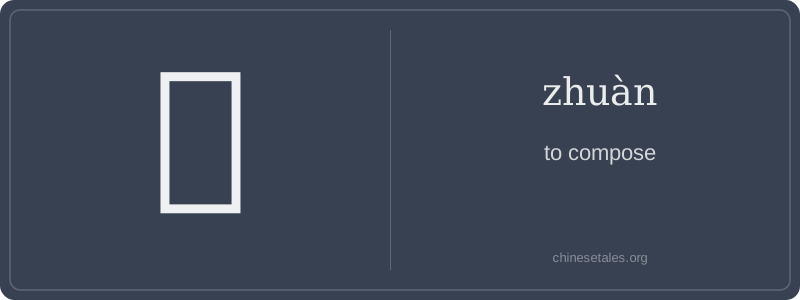
The earliest forms of 撰 appear in Warring States bamboo slips — not as a pictograph, but as a semantic-phonetic compound already. Its left side 扌 (hand radical) signals physical or intentional action; the right side is 肙 (yuān), an ancient phonetic component derived from a now-obsolete character meaning 'to select' or 'to gather'. Over centuries, 肙 simplified into the modern 彐 + 口 + 爫 structure — look closely: the top resembles a stylized hand reaching down (彐), the middle suggests containment or selection (口), and the bottom evokes claws or grasping (爫). This visual evolution reflects its core idea: the hand *selecting and arranging* characters deliberately.
In the Shuōwén Jiězì (121 CE), Xu Shen defined 撰 as 'to gather and compose texts', highlighting its classical use for compiling classics or editing histories. By the Tang dynasty, it appeared in imperial edicts like '敕撰《晋书》' (chì zhuàn Jìn Shū) — 'Imperially commissioned to compile the Book of Jin'. The character never meant 'to write quickly' or 'to jot down'; its essence has remained remarkably stable: *intentional, authoritative textual creation*. Even today, when a university appoints a professor to 撰写校史 (zhuàn xiě xiào shǐ), they’re entrusting them with shaping institutional memory — not just recording facts, but curating legacy.
At its heart, 撰 (zhuàn) is the quiet, deliberate act of *crafting words with intention* — not just typing or scribbling, but composing a text as if assembling fine porcelain: each phrase weighed, each clause fitted. It carries scholarly gravity and implies authorship, authority, and effort. You won’t hear it in casual chat ('I wrote a WeChat message' uses 写), but in contexts like drafting a white paper, penning a preface, or compiling an academic anthology.
Grammatically, 撰 is almost always transitive and formal — it takes a direct object, often a noun denoting a written work: 撰写报告 (zhuàn xiě bàogào, 'compose a report'), 撰序 (zhuàn xù, 'write a preface'). Note the common compound 撰写 — where 撰 intensifies 写, adding weight and formality. Learners sometimes overuse it like a fancy synonym for 写, but that’s like using 'pen' instead of 'write' in every sentence — charming at first, then jarring. Also, it rarely appears in the past tense alone; you’ll see it in verb phrases (e.g., 已撰成, 'has been composed') or passive constructions (被撰于…, 'was composed in…').
Culturally, 撰 evokes the Confucian ideal of the scholar-author: someone whose words carry moral weight and historical responsibility. In classical texts, 撰 appears in phrases like 撰《春秋》 (zhuàn Chūnqiū), referring to Confucius’s editing of the Spring and Autumn Annals — not mere writing, but *authoritative compilation*. A frequent slip? Using 撰 when you mean 'edit' (编) or 'draft casually' (草拟). Remember: 撰 = hand + 'to choose and arrange' — it’s composition with care, not composition with haste.