摞
Character Story & Explanation
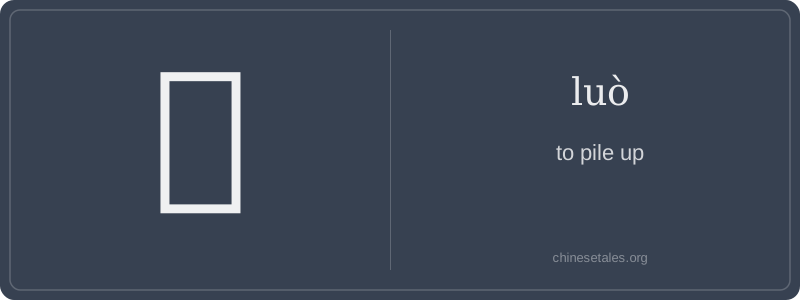
The earliest form of 摞 isn’t found in oracle bones, but its components tell a vivid story: left side 扌 (hand radical) signals action by hand; right side 罗 (luó, originally a net-like mesh pattern) evolved from ancient bronze script depicting interwoven threads — symbolizing containment and layering. Over time, 罗 simplified and fused with 扌, and the lower part stabilized into 一 + 冂 + × (a stylized 'X' representing crossed layers), giving us today’s 14-stroke structure: a hand actively organizing intersecting strata — visually echoing how stacked items overlap at corners.
By the Tang dynasty, 摞 appeared in poetry describing orderly arrangement — Li Bai didn’t 摞 wine cups, but later Song scholars used it in household manuals for stacking lacquerware. Its meaning never broadened into abstraction (unlike 堆, which can mean 'a pile of trouble'); 摞 stayed stubbornly physical and manual. Even today, you wouldn’t say 摞感情 or 摞压力 — it demands tangible, stackable objects. The character’s visual weight — that dense, layered right half — mirrors its semantic weight: stacking isn’t passive accumulation; it’s choreographed control.
Think of 摞 (luò) as Chinese stacking cups meets IKEA assembly instructions — it’s not just 'to pile up', it’s the deliberate, gravity-defying act of arranging things in neat, vertical order: books on a shelf, plates after dinner, or even bureaucratic documents waiting for your signature. Unlike generic verbs like 堆 (duī), which implies haphazard piling (like laundry on a chair), 摞 carries quiet precision — you *摞* what you intend to handle as a unit, often with hands (hence the 扌 radical). It’s tactile, intentional, and slightly formal.
Grammatically, 摞 is almost always transitive and used in verb–object constructions: you 摞书, 摞碗, 摞文件 — never just 'I pile' alone. It rarely appears in compound verbs (no 摞起 or 摞下), and never in past-tense suffixes like 了 unless paired with aspect particles carefully: 他把书摞好了 (He neatly stacked the books). Learners often mistakenly use it like 堆 or 放, leading to unnatural sentences like *我摞在桌子上 (❌) — correct is 我把书摞在桌子上 (✓).
Culturally, 摞 evokes domestic order and quiet competence — the grandmother who 摞齐三叠碗 before washing; the office worker who 摞好报销单 before submitting. It’s uncelebrated but deeply embedded in daily ritual. Because it’s absent from HSK, learners encounter it first in real-life contexts (menus, signs, family talk) — making it a delightful 'aha!' moment when they realize this elegant little character names something they’ve done a thousand times.