搣
Character Story & Explanation
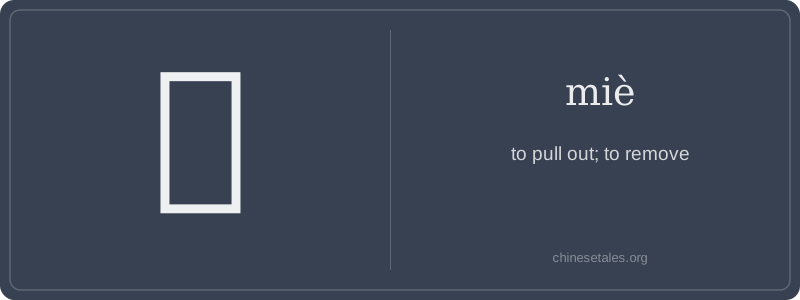
The earliest form of 搣 appears in late Warring States bamboo slips as a composite glyph: left side 扌 (hand radical), right side 厅 — but wait! That ‘厅’ isn’t today’s ‘hall’. It’s a phonetic-semantic hybrid: the top part (厶) mimicked a bent finger hooking something, while the bottom (口) suggested containment or a small opening — together evoking ‘hand gripping and drawing out from a confined space’. Over centuries, 厅 simplified into the modern 灭-like shape (but note: it’s NOT 灭!), losing its mouth component and gaining angular strokes to emphasize the sharp, decisive motion of extraction.
By the Han dynasty, 搣 was already specialized for fine manual removal — unlike broader verbs like 取 (qǔ, 'to take') or 拿 (ná, 'to hold'). In the 16th-century novel Jin Ping Mei, a maid is described 搣下一根白发 (miè xià yī gēn bái fà) — highlighting both precision and quiet intimacy. The character’s visual austerity (clean lines, no flourishes) mirrors its semantic focus: no wasted motion, no ambiguity — just hand + targeted extraction. Its rarity in standard texts isn’t due to obscurity, but to its perfect niche: when Chinese needs *exactly* that kind of finger-tipped pull, 搣 answers.
Let’s get real: 搣 (miè) is a stealthy, high-precision verb — not for casual removal, but for *deliberate, finger-based extraction*. Think tweezers with intent: pulling out a splinter, plucking a single eyebrow hair, or yanking a stubborn weed root. It’s tactile, manual, and implies control — never used for abstract 'removal' like deleting files or canceling plans. Its core feel is *micro-action with resistance*: you’re overcoming slight friction, often with fingers or tools in hand.
Grammatically, 搣 is almost always transitive and requires an object — you can’t just ‘miè’ into the air. It frequently appears in serial verb constructions (e.g., 搣出来 miè chūlái — 'pull out') or as part of compound verbs like 搣掉 (miè diào, 'pluck off'). Learners often overgeneralize it — don’t use it for turning off lights (关 guān) or deleting text (删 shān). Also, watch tone: miè (4th) is easily mispronounced as miē (1st) or miě (3rd), which are non-existent for this character.
Culturally, 搣 shows up in folk medicine, craft traditions, and regional dialects more than formal writing. In classical texts, it’s rare — you’ll find it more in Ming-Qing vernacular novels describing meticulous physical acts (e.g., a herbalist 搣断草根 to test freshness). Modern usage leans colloquial and vivid: it adds sensory texture. A common mistake? Confusing it with 掰 (bāi, 'to break apart with hands') — but 搣 is *linear extraction*, while 掰 is *bilateral separation*.