搠
Character Story & Explanation
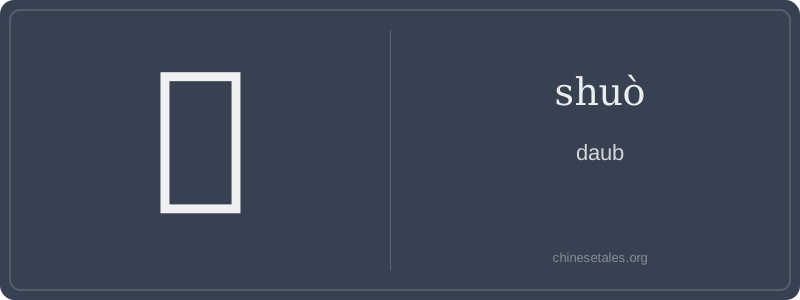
Oracle bone inscriptions show no direct precursor for 搠 — it emerged later, during the Warring States period, as a phono-semantic compound. Its modern form crystallized by the Han dynasty: left side 扌 (hand radical, simplified from 手) signals manual action; right side 朔 was borrowed for sound but also carried connotations of ‘origin’ and ‘unfolding’ — imagine the first daub on virgin paper, marking the genesis of a scroll. Visually, the 13 strokes flow downward: the hand radical anchors the action, while the 朔 component’s sharp angles (like the ‘gate’ 门 inside 朔) evoke the edge of a trowel or brush pressing into soft material.
By the Tang and Song dynasties, 搠 appears in texts like the *Treatise on Inkstones* (砚谱), describing how master craftsmen 搠 lacquer onto wooden cores before carving. In Yuan drama, it’s used metaphorically: ‘he 搠 his sorrow onto the silk fan’ — turning emotion into visible, thick, inescapable stain. That layered meaning — physical act + emotional weight — is why it endures in literary Chinese despite vanishing from daily speech. Its visual heft mirrors its semantic weight: every stroke feels like pressure applied.
Let’s get tactile: 搠 (shuò) is all about *wet, messy, deliberate application* — think daubing paint thickly onto a wall, smearing ink across silk, or even plastering mud onto a wattle-and-daub hut. It’s not light brushing (that’s 涂 tú); it’s forceful, textured, almost physical — the ‘shuò’ sound itself has a guttural, abrupt quality, like a spatula scraping clay. The 扌 (hand) radical makes it clear this is an action done *with the hand*, while the right side, 朔 (shuò), originally meant ‘first day of the lunar month’ but here serves phonetically — and subtly hints at *beginning anew*, as if each daub marks a fresh start on a blank surface.
Grammatically, 搠 is almost exclusively a verb, used transitively with concrete, viscous substances: ink, lacquer, paste, mortar. You’ll rarely see it in modern spoken Mandarin — it’s literary, poetic, or technical (e.g., traditional painting or carpentry manuals). Learners often misread it as shuò (correct) but then wrongly assume it means ‘to strike’ (like 擊 jī) because of the hand radical — nope! This is *application*, not impact. Also, never use it for liquids like water or tea — that’s dripping, pouring, or splashing, not daubing.
Culturally, 搠 survives most vividly in classical poetry describing ink-smeared calligraphy brushes or Song-dynasty artisans applying gold leaf to lacquerware. A common mistake? Confusing it with 朔 (shuò, ‘new moon’) — identical pronunciation, but 朔 has no 扌 and means time, not touch. Think: ‘hand + new moon’ = hand applying something *fresh*, like the first stroke of a new month’s work.