搒
Character Story & Explanation
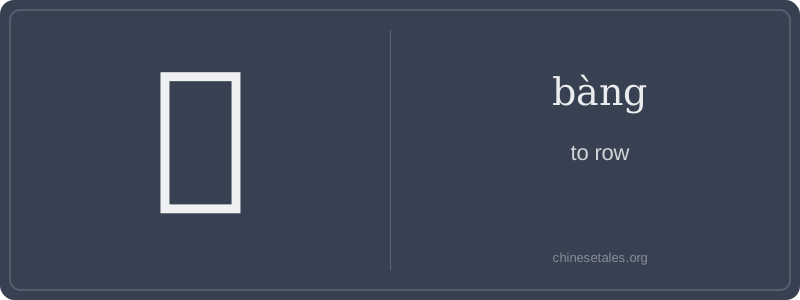
The earliest form of 搒 appears in bronze inscriptions from the late Zhou dynasty as a composite: a hand (又) gripping a long, segmented pole — unmistakably an oar — beside a simplified representation of flowing water (often implied by wavy strokes or later standardized as 竹, hinting at bamboo oars). Over centuries, the hand evolved into the standard 扌 radical, the oar became stylized into the top component resembling 竹 (though not the full bamboo radical), and the lower part solidified into a phonetic element (夅, later simplified in clerical script to its current form). By the Han dynasty, the structure stabilized at 13 strokes — every stroke echoing muscle, resistance, and rhythm.
This character didn’t just describe movement — it anchored identity. In the *Chu Ci* (Songs of Chu), Qu Yuan uses 搒 metaphorically: 'I row my boat against the current of fate' — turning physical labor into moral resolve. Later, in Tang poetry, 搒 appears in pastoral scenes where rowing symbolizes retreat from court politics. Crucially, its visual form — hand + vertical pole + downward stroke — mimics the biomechanics of pulling an oar: grip, push down, lift. Even today, calligraphers note how the final捺 (nà) stroke sweeps leftward like water parting under the blade.
At first glance, 搒 (bàng) feels like a quiet relic — it means 'to row', but you’ll almost never hear it in modern Mandarin conversation. Unlike common verbs like 划 (huá) or 摇 (yáo), 搒 carries the rhythmic, labor-intensive weight of ancient river transport: think bamboo rafts on the Yangtze, oars biting deep into slow, silt-heavy water. Its core feeling isn’t speed or leisure — it’s steady, synchronized effort, often collective and physically demanding.
Grammatically, 搒 is a transitive verb that typically takes a boat or raft as its object (e.g., 搒船). It rarely appears in progressive or perfective aspects in contemporary usage; instead, it surfaces mostly in literary descriptions, historical reenactments, or poetic set phrases like 搒桨 (bàng jiǎng, 'to row the oar'). You won’t find it in HSK textbooks because it’s functionally archaic — native speakers reach for 划船 or 荡舟 instead. Learners who force 搒 into casual speech risk sounding like a Tang-dynasty scholar quoting Li Bai at a café.
Culturally, 搒 reveals how Chinese lexical memory preserves embodied labor — not just *what* was done, but *how the body moved* to do it. The character’s hand-radical (扌) plus 'bamboo' (竹-like top) subtly encodes both human action and the material tool. A common mistake? Confusing it with 棒 (bàng, 'stick') — same sound, same radical position, but no semantic link to motion. That slip turns 'rowing upstream' into 'holding a club.'