揶
Character Story & Explanation
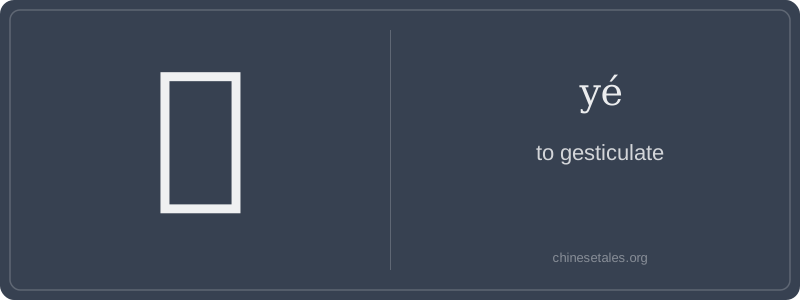
Tracing back to seal script (c. 3rd century BCE), 揶 began as a hand radical (扌) fused with 右—a character originally depicting a right hand holding a ritual jade tablet. But here’s the twist: 右 was borrowed *phonetically*, not semantically. Early scribes needed a sound-alike for ‘yé’, and 右 (then pronounced closer to *ngjuk* in Old Chinese) fit the bill. Over centuries, the hand radical stabilized, while 右 simplified from a detailed hand+jade glyph into today’s clean 5-stroke form—yet the visual echo remains: a hand *reaching rightward*, as if gesturing aside, away from seriousness.
This playful phonetic borrowing shaped its meaning profoundly. By the Tang dynasty, 揶 appears in anecdotal collections like *Youyang Zazu* (‘Miscellaneous Morsels from Youyang’), where scholars ‘揶揄’ each other with witty, hand-accented banter—never shouting, always gesturing. The character became synonymous with intellectual teasing: a raised palm, a flick of fingers, a knowing half-smile. Its evolution mirrors Chinese literati culture itself: meaning isn’t just in the word, but in *how* you move while saying it.
Let’s cut through the mystery: 揶 (yé) isn’t about random waving—it’s *intentional*, often *playful or mocking* gesticulation: a raised eyebrow + flick of the wrist, a sarcastic shoulder shrug, or that classic ‘I’m not even mad, I’m impressed’ finger-tap on the temple. It’s highly literary and stylistically marked—think of it as the Chinese equivalent of an italicized stage direction in a script: *‘(she rolls her eyes and gestures dismissively)’*. You’ll almost never hear it in casual speech; it lives in essays, satire, and classical-inspired prose.
Grammatically, 揶 is almost always paired with another verb—especially 揶揄 (yé yú), meaning ‘to tease/mock with gestures and words’. It rarely stands alone: you wouldn’t say ‘他揶了’—you’d say ‘他揶揄我’ or ‘他一边揶揄一边挥手’. It’s transitive and action-oriented, requiring an object (a person or idea being teased), and it carries a light, performative weight—not aggression, but theatrical irony.
Here’s where learners stumble: they confuse 揶 with generic ‘move’ verbs like 挥 (huī, ‘to wave’) or 比 (bǐ, ‘to gesture’). But 揶 is never neutral—it’s loaded with tone, attitude, and social nuance. Also, its radical 扌 (hand) + 右 (right) isn’t about ‘right hand’ literally—it’s phonetic (右 yòu sounds close to yé) *and* subtly ironic: the ‘right’ hand performing ‘wrong’-headed teasing. Don’t force it into spoken Mandarin—save it for writing where wit and subtlety shine.