揥
Character Story & Explanation
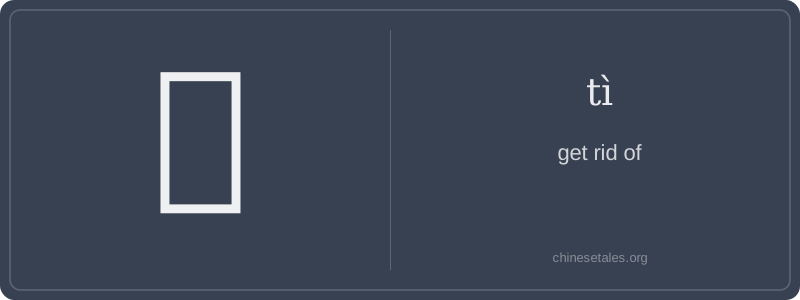
Carved on late Shang oracle bones, the earliest form of 揥 resembled a hand (扌) gripping a sharp, curved tool — possibly a bronze awl or ritual knife — thrust downward into something soft and yielding. That ‘something’ was originally drawn as a wavy line (like water or vapor), symbolizing intangible impurity or obstruction. Over centuries, the wavy line hardened into the ‘弟’ component (not the word for ‘younger brother’, but a phonetic-semantic remnant), while the hand radical stayed anchored left. By Han dynasty clerical script, the shape had stabilized: 扌+弟 — visually, a hand wielding decisive action against what must be expelled.
The meaning evolved from concrete ritual act — priests using blades to remove tainted offerings — to philosophical abstraction. In the Xunzi, 揥 appears in passages urging scholars to ‘tì qù xīn zhōng zhī huò’ (remove doubts from the heart). Later, in Tang poetry, it acquired lyrical force: ‘yún kāi wù 揥’ (clouds part, mist is removed) — not just clearing weather, but epiphany. Its visual logic remains striking: the ‘弟’ component, though now phonetic, echoes ‘order’ and ‘subordination’ — implying that true removal restores proper hierarchy, whether in nature or the mind.
Let’s be honest: 揥 (tì) is a ghost character — elegant, ancient, and nearly extinct in modern speech. Its core meaning 'to get rid of' carries a visceral, almost physical sense of removal: not just deleting text or declining an offer, but *wrenching away*, like plucking a thorn or discarding something impure. It’s not polite abstraction — it’s action with intent and finality. You’ll rarely hear it in casual chat; it lives in classical texts, legal documents, and poetic diction where precision and gravity matter.
Grammatically, 揥 functions as a transitive verb, usually followed by what’s being removed — often abstract things (doubts, obstacles, flaws) or undesirable states (sorrow, stagnation). Unlike common synonyms like 除 (chú) or 去 (qù), 揥 resists colloquialization: you’d never say ‘我帮你剟掉这个错字’ — that’s not how 揥 rolls. It demands literary weight. A classic pattern is 揥去 (tì qù) or 揥除 (tì chú), both formal compounds meaning ‘to eliminate’. Learners sometimes force it into everyday contexts — big mistake. Using 揥 instead of 删 (shān) to mean ‘delete a file’ sounds like quoting Zhuangzi at a Zoom meeting.
Culturally, 揥 whispers of ritual purification and Confucian self-cultivation — think of removing moral impurities from one’s character, as in the phrase 揥瑕 (tì xiá): ‘removing blemishes’ (figuratively, refining virtue). Mistake? Assuming it’s interchangeable with 剔 (tī), which means ‘to pick out’ or ‘carve away’ — same radical, similar sound, but 揥 is about *wholesale removal*, while 剔 is about *precise extraction*. Also, watch the tone: tì (4th) ≠ tī (1st) — mispronouncing it makes your sentence vanish into semantic fog.