揝
Character Story & Explanation
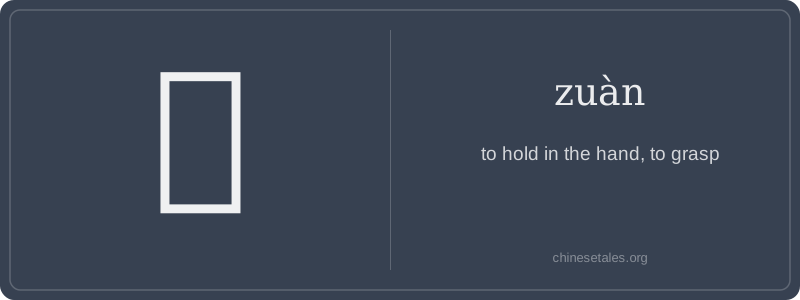
The earliest form of 揝 appears not in oracle bones, but in late Warring States bamboo slips and Han dynasty seal script — a deliberate fusion character. Its left side 扌 (hand radical) is standard, but the right side 攢 (zǎn, 'to gather, accumulate') was chosen not for sound alone, but for semantic resonance: gathering force into the palm. In clerical script, the right component simplified from the complex 'two hands collecting grain' glyph to today’s compact 攒-like shape, while the hand radical stabilized into its modern three-stroke form. Crucially, 揝 was *invented* — not evolved organically — as a variant of 攢 to emphasize *manual accumulation*: not gathering things *together*, but gathering *power into the hand*.
This intentional creation explains its literary scarcity: 揝 appears only once in the entire *Shuōwén Jiězì* (121 CE), labeled a 'regional variant for vigorous holding'. By the Ming dynasty, it thrived in vernacular novels like *Water Margin*, where heroes 揝刀、揝枪 — verbs that make weapons feel alive in the grip. The character’s very architecture — hand + 'gathering' — encodes its philosophy: grasping isn’t passive reception; it’s the active concentration of will into fingertips. That’s why 揝 never means 'to hold gently' — gentleness requires 捏 (niē) or 托 (tuō). 揝 is commitment made muscular.
Think of 揝 (zuàn) as Chinese’s version of the emphatic English verb 'to clench' — not just 'hold', but hold *with intention*, *force*, or *urgency*. It conveys tactile intensity: fingers closing hard, knuckles whitening, a grip that says 'I won’t let go'. Unlike the neutral 抓 (zhuā, 'to grab') or 拿 (ná, 'to take/handle'), 揝 is visceral and physical — you 揝 a rope before climbing, 揝 your child’s hand in a crowd, or 揝 a fist in anger. It’s rarely used abstractly; you wouldn’t 'grasp an idea' with 揝.
Grammatically, it’s a transitive verb requiring a concrete, graspable object — no metaphors, no passive voice. You’ll almost always see it in the structure [Subject] + 揝 + [Noun], often paired with aspect particles like 着 (zhe) for continuous action ('holding tightly') or 住 (zhù) for successful completion ('grip firmly'). Learners mistakenly use it where 拿 fits better — e.g., saying '我揝书' instead of '我拿书' ('I’m holding the book') — which sounds oddly aggressive, like you’re wrestling the textbook.
Culturally, 揝 appears most vividly in martial arts manuals, folk opera stage directions ('英雄揝剑而立' — 'The hero stands gripping his sword'), and regional dialects (especially Northern Mandarin), where it carries rustic, unrefined strength. It’s absent from formal writing and HSK lists precisely because it’s too bodily, too raw — like using 'clench' instead of 'hold' in a legal document. Native speakers instinctively reach for 揝 when they want to summon tension, resistance, or resolve — not convenience.