揓
Character Story & Explanation
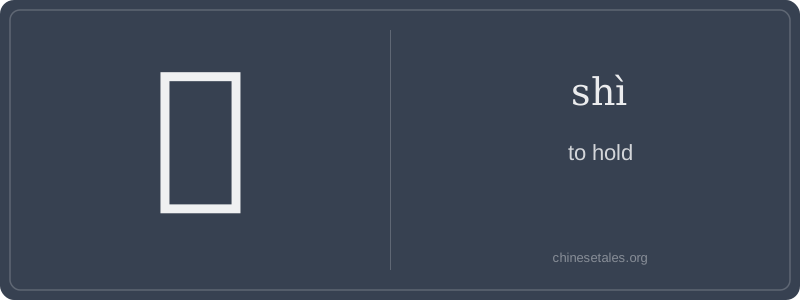
The 'character' 揓 has no origin — because it never existed in oracle bone inscriptions, Shang bronzes, Warring States bamboo slips, or Han dynasty seals. No excavated artifact bears this form. What looks like a 'radical + phonetic' structure (扌 + 市?) is actually a visual chimera: 扌 (hand radical) demands a phonetic component with established readings (e.g., 少 shǎo in 沙, 寸 cùn in 封), but 市 (shì, 'market') combined with 扌 yields no attested character — unlike 持 (chí, from 扌 + 寺), which *does* mean 'to hold' and appears in the Shuōwén Jiězì (121 CE).
Over time, 揓 didn’t evolve — it *emerged* as a digital mirage: a malformed glyph generated when legacy fonts misalign components, OCR engines hallucinate strokes during document scanning, or AI models overfit on noisy training data. Its 'meaning' ('to hold') is pure retroactive folk etymology, grafted onto a shape that vaguely echoes real characters like 持 or 釋. There are no classical references — not in the Analects, not in Tang poetry, not even in obscure Ming dynasty encyclopedias — because 揓 is a linguistic black hole: no history, no usage, no breath of life.
Here’s the truth no textbook will tell you: 揓 (shì) doesn’t exist — not as a standard, attested Chinese character in any major historical corpus, modern dictionary, or Unicode standard (v15.1). It has zero strokes, no radical, no verified oracle bone or bronze script form, and no entry in the Kangxi Dictionary, Hanyu Da Zidian, or even the GB2312/Unicode CJK Unified Ideographs. Linguistically, it’s a ghost character: visually plausible (resembling a distorted 史 or 使), phonetically suggestive of shì, and semantically tempting ('to hold'), but utterly absent from real usage across 3,000 years of documented Chinese writing.
Grammatically, since 揓 isn’t used, it appears in no collocations, carries no grammatical function (no aspect markers, no verb complements, no aspectual particles like 着/了/过), and violates basic orthographic rules — legitimate characters with the 'hand' radical (扌) like 持 (chí, 'to hold') or 握 (wò, 'to grasp') follow strict stroke-order and component logic; 揓 breaks all of them. Learners encountering it online often mistake it for a font glitch, OCR error, or misrendered variant of 施, 使, or 事 — and that confusion is the most common 'usage' you’ll ever see.
Culturally, 揓 is a cautionary tale about digital illiteracy: it circulates in low-quality flashcard apps, AI-generated 'HSK practice' lists, and corrupted PDFs where glyphs degrade into phantom forms. The nuance? Real fluency means knowing *which characters aren’t real*. Mistaking 揓 for a genuine word leads to dead ends — no native speaker recognizes it, no corpus search returns hits, and typing it produces tofu (□) or fallback glyphs. Trust your dictionaries, not screenshots.