掮
Character Story & Explanation
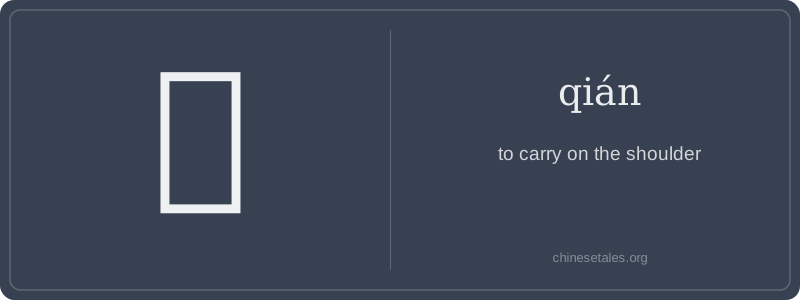
The earliest form of 掮 appears in seal script as a combination of 扌 (hand radical, indicating action) and 廾 (gǒng, meaning ‘to hold with both hands’ — originally two hands facing upward). But crucially, the right side evolved into 兼, which itself began as a pictograph of *two bamboo stalks bound together over a shoulder*, visually mirroring how porters carried dual loads. Over centuries, the top strokes simplified, the ‘two stalks’ merged into the double ‘v’ shape of 兼, and the hand radical solidified — yielding today’s 11-stroke form: three strokes for 扌, eight for 兼.
This visual logic cemented its meaning: not just ‘hold’, but ‘hold *across the shoulder*’. In the *Shuōwén Jiězì* (121 CE), it’s defined as ‘to bear upon the shoulder’, citing classical usage in texts describing ritual transport of ancestral tablets. By the Ming and Qing dynasties, 掮 became synonymous with professional porters (*qiánfū*) — men licensed to carry goods in cities, often depicted in woodblock prints bent under poles, faces taut with effort. The character’s very structure — hand + ‘dual load over shoulder’ — is a miniature biomechanical diagram written in ink.
Imagine a bustling 1930s Shanghai dock: sweat glistens on laborers’ brows as they heave heavy bamboo poles across their shoulders, each pole balanced with two wicker baskets — one full of rice, the other of porcelain. That distinctive, slightly stooped posture — weight distributed squarely *on the shoulder*, not in the arms or hands — is precisely what 掮 captures. This isn’t just ‘to carry’; it’s *shoulder-carrying* as a physical act, a cultural image of endurance, and historically, a marker of manual laborers (like coolies or porters). It feels grounded, visceral, and quietly dignified — never abstract or metaphorical.
Grammatically, 掮 is almost always transitive and action-oriented: you 掮 something *specific*, usually bulky or awkward — a ladder, a coffin, a sack of coal. You won’t say ‘I 掮 my backpack’ (that’s 背); instead, you’d 掮 a wooden beam during temple restoration. It rarely appears in modern spoken Mandarin outside literary, historical, or regional contexts (e.g., Taiwan or southern dialect-influenced writing), and it’s almost never used reflexively or in compound verbs like ‘carry out’ — that’s 执行. Learners often mistakenly use it where 拿 or 提 would be natural, missing its strong semantic anchor to *shoulder placement* and *weight-bearing posture*.
Culturally, 掮 evokes vanished urban landscapes — rickshaw pullers, street vendors with shoulder poles (called *dànzi*), and the quiet heroism of physical labor. Its rarity today makes it a subtle time capsule: when you see it in a novel or film subtitle, you’re not just reading ‘carry’ — you’re stepping onto a cobblestone alley at dawn, hearing the creak of bamboo under load. Mispronouncing it as qiǎn (a common slip) risks sounding like the rare verb ‘to scold’, so tone precision matters!