掬
Character Story & Explanation
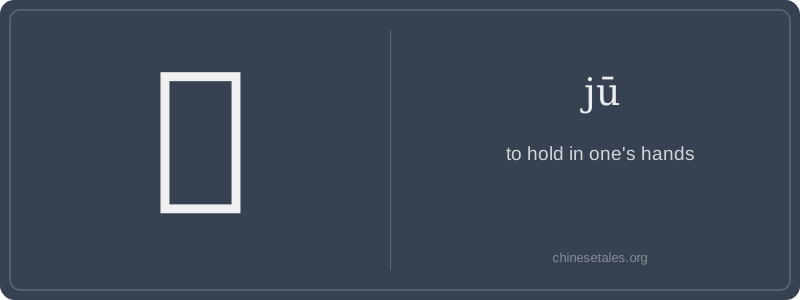
The earliest form of 掬 appears in seal script as a combination of 扌 (hand radical) and 米 (mǐ, ‘rice’), but crucially, the 米 component wasn’t about grain — it was a stylized depiction of *cupped hands*, with the four dots representing fingers curling inward. Over time, 米 simplified into the modern ‘米’ shape we see today, though its function shifted from pictograph to phonetic clue (the ancient pronunciation of 米 and 掬 were closely related). The left side, 扌, remained steadfast — anchoring the meaning in manual action. Every stroke tells a story: the three horizontal strokes of 扌 mimic fingers moving; the crossed lines in 米 echo the crisscross of thumbs meeting palms.
This character first appeared in bronze inscriptions over 2,500 years ago, used in ritual contexts — priests ‘gathering’ sacred water or incense smoke with cupped hands. By the Han dynasty, it entered poetry as a metaphor for emotional containment: Du Fu wrote of ‘掬泪’ (jū lèi — ‘cupping tears’), evoking someone gathering their sorrow before it falls. Its visual logic is perfect: the hand radical reaches out, and the 米 component forms a visual ‘bowl’. Even today, when you write those 11 strokes, your hand instinctively curves — the character literally shapes your gesture.
Imagine standing barefoot at the edge of a mountain stream in spring — water clear and cold, sunlight dappling the stones. You crouch down, cup your hands like two small bowls, and gently lift a handful of water to your face. That soft, deliberate, almost reverent motion — not scooping, not grabbing, but *holding* something precious and fluid in your palms — is exactly what 掬 (jū) captures. It’s not just ‘to hold’; it’s to cradle with intention, often with both hands, usually something that could slip away: water, light, petals, or even abstract things like joy or sorrow.
Grammatically, 掬 is a transitive verb that almost always appears with an object and frequently pairs with measure words like ‘一掬’ (yī jū — ‘a handful of’). You’ll rarely see it alone — it thrives in poetic or literary contexts: ‘掬水月在手’ (jū shuǐ yuè zài shǒu — ‘I scoop water and the moon rests in my palm’). Learners sometimes mistakenly use it like 抓 (zhuā, ‘to grab’) or 拿 (ná, ‘to take’), but 掬 implies gentleness, fullness of gesture, and often a tactile, sensory moment — never urgency or force.
Culturally, 掬 carries quiet elegance — it appears in Tang dynasty poetry, Chan Buddhist verses, and classical garden inscriptions. Modern usage is rare in speech, so misusing it sounds oddly archaic or overly flowery. A common pitfall? Confusing it with 推 (tuī, ‘to push’) due to similar radicals — but 掬 has no thrust, only tender containment. Think of it as the verb form of a porcelain bowl held just so: graceful, precise, and deeply human.