掔
Character Story & Explanation
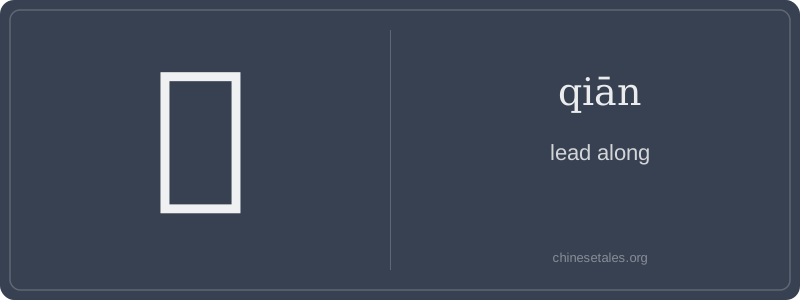
The earliest form of 掔 appears in Warring States bamboo slips, not oracle bones — and it’s stunningly literal. It combines 扌 (hand radical) with 牵 (qiān, 'to lead, to tether'), but originally depicted a hand gripping a rope attached to an ox’s nose ring — a clear image of gentle, controlled guidance. Over centuries, the rope simplified into the 'radical-like' top component (), while the ox (牛) evolved into the lower 口 + 玄 shape, eventually standardizing into today’s elegant, compact form with its distinctive 'hooked' upper stroke suggesting restraint and direction.
This visual logic carried straight into meaning: from herding livestock to guiding people. In the Book of Rites (Lǐjì), 掔 appears in descriptions of ritual processions where elders 'lead along' juniors by the sleeve — a gesture symbolizing moral mentorship. Later, in Ming-Qing vernacular novels, it described mothers 掔着孩子走过石桥 — the tactile intimacy of that grip conveying safety and continuity. Even today, calligraphers note how the final downward stroke curves like a finger curling around a small hand — a silent grammar of care.
Let’s be honest: 掔 (qiān) is a quiet, almost ghostly character — it doesn’t shout, but it *guides*. Its core meaning — 'to lead along', 'to conduct gently by the hand' — carries warmth and intentionality, not force. Think of leading a child across a busy street, or ushering an elder into a room: it’s physical, respectful, and deeply relational. Unlike 拉 (lā, 'to pull') or 带 (dài, 'to take/bring'), 掔 implies tender, step-by-step guidance — often with hands involved, and always with care.
Grammatically, 掔 is rare in modern spoken Mandarin and appears mostly in literary, classical, or regional contexts (especially in southern dialect-influenced writing or historical fiction). It’s a verb that usually takes a direct object and often appears in compound verbs like 掔着 (qiān zhe, 'holding and leading') or in fixed phrases like 掔手同行 (qiān shǒu tóng xíng, 'to walk hand in hand'). You won’t find it on restaurant menus or subway signs — but you *will* spot it in Tang dynasty poetry describing a scholar guiding his disciple up a misty mountain path.
Culturally, 掔 reflects a subtle Confucian ideal: authority expressed through accompaniment, not command. Learners often misread it as 搴 (qiān, 'to pluck') due to identical pronunciation and similar stroke density — a mix-up that turns 'leading a friend home' into 'plucking a flower'. Also, don’t confuse its delicate motion with the blunt action of 推 (tuī, 'to push') or 拉 (lā). 掔 is never urgent, never rough — it breathes patience.