捩
Character Story & Explanation
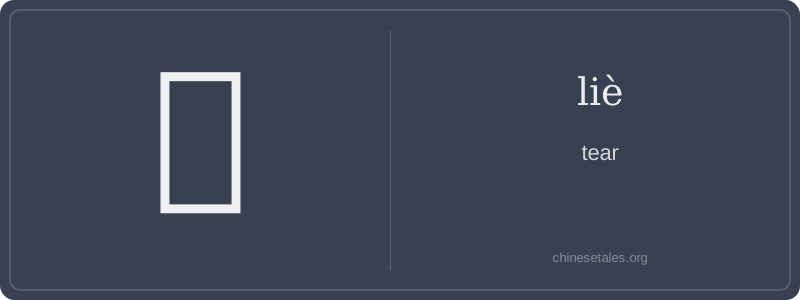
The earliest form of 捩 appears in Warring States bamboo slips as a hand radical (扌) gripping a bent, zigzagging line — not a straight stroke, but a sharp, angular 'V' shape with a hook at the end, evoking a finger twisting a rope or tendon. Over centuries, the zigzag simplified into the right-side component 例 (lì), though this is purely phonetic — the original pictograph was all about *hand + angular torsion*. By the Han dynasty, the structure stabilized: left side 扌 (hand action), right side 例 (sound clue only), but the visual memory of that jagged, wrenching motion remained embedded in the 11 strokes — especially the final downward hook, which mimics the snap of something giving way.
This torsional origin directly shaped its semantic evolution. In the Shuōwén Jiězì (2nd c. CE), 捩 is defined as 'to turn and break', emphasizing the inseparability of rotation and rupture. Tang poets used it for twisting sorrow into song ('捩歌喉', 'twist one’s throat to sing'), while Ming medical texts described joint manipulation techniques involving deliberate, controlled 捩. The character never lost its edge: whether describing a snapped tendon in classical medicine or a geopolitical pivot in today’s newspapers, 捩 always implies forceful, irreversible change born of torque — a linguistic embodiment of physics meeting emotion.
Think of 捩 (liè) as the Chinese equivalent of a chef violently twisting a lemon half to squeeze out every last drop — not gentle pressing, but a sharp, torsional *wrench* that tears resistance apart. Its core meaning isn’t just ‘tear’ like ripping paper; it’s *twist-and-tear*, a forceful, almost violent contortion that breaks continuity — imagine twisting a wire until it snaps, or wrenching a stubborn lid off a jar until the seal gives way with a pop. That visceral sense of torsion + rupture is baked into every usage.
Grammatically, 捩 is almost never used alone. It appears primarily in compound verbs like 捩断 (liè duàn, 'to twist off/snatch away') or 捩转 (liè zhuǎn, 'to abruptly twist/turn'). It’s also common in literary and formal contexts — you’ll rarely hear it in casual speech, but you’ll see it in news headlines about policy shifts ('政策急捩') or martial arts manuals describing joint locks. Learners often mistakenly use it where 扯 (chě, 'pull') or 撕 (sī, 'rip') would fit — but 捩 always implies rotation *plus* breaking, not linear force.
Culturally, 捩 carries subtle connotations of abruptness, even recklessness — a sudden, jarring departure from expected motion. Classical texts use it for twisting fate or distorting truth (e.g., 捩曲, 'to warp'), and modern writers deploy it for political U-turns or emotional breakdowns. A frequent learner trap: confusing its sharp, angular energy with softer synonyms like 转 (zhuǎn, 'turn') — but 捩 has no smoothness. It’s the sound of something snapping under torque.