挟
Character Story & Explanation
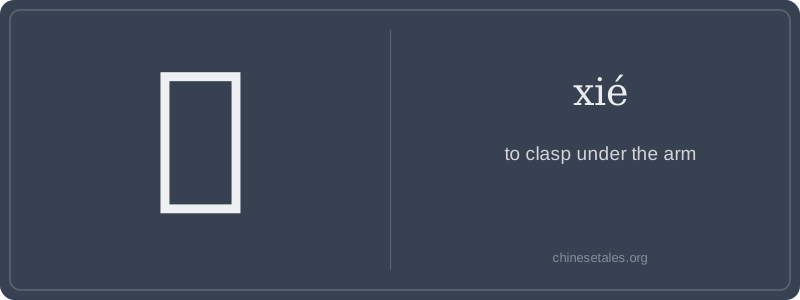
The earliest form of 挟 appears in bronze inscriptions as two hands (, later simplified to 扌) flanking a phonetic component 陜 (xiá, meaning ‘narrow pass’), which itself evolved from a pictograph of a mountain gorge. The original idea was visceral: ‘grasping on both sides of a narrow space’—like seizing someone by the arms in a tight alley. Over centuries, the right side simplified from 陜 to 夾 (jiā, ‘to grip between’), then further streamlined to 荚 (jiá, ‘pod’), and finally to the modern 夾-like shape we see today—9 clean strokes that still echo that bilateral grip.
This visual logic directly shaped its semantic journey. From concrete ‘holding under the arm’ (as in ancient travelers carrying bamboo slips), it extended metaphorically to ‘holding sway over’: Mencius used 挟长以令幼 (‘using seniority to command juniors’) to critique hierarchical coercion. By the Han dynasty, it was firmly entrenched in political lexicon—always implying leverage, never mere contact. Even today, the stroke order (starting with the left hand radical, then the right-side ‘grip’ structure) mirrors the act: first the agent, then the constraining action.
At its heart, 挹 (xié) isn’t just about physical clamping—it’s about *controlled possession*: holding something close, often with intent, sometimes even coercively. Think of a scholar clutching precious scrolls under one arm while striding through a crowded market, or a warlord ‘holding’ a ruler hostage—not just gripping, but asserting leverage. That subtle tension between protection and pressure is baked into the character’s DNA.
Grammatically, 挟 is almost always transitive and verb-initial, often followed by an object and then a purpose clause (e.g., 挟…以…). It rarely stands alone—unlike English ‘clasp’, it implies consequence: 挟持 (xiéchí) means ‘to take hostage’, 挟势 (xiéshì) means ‘to wield power/authority’. Learners mistakenly use it like 抱 (bào, ‘to hug’) or 拿 (ná, ‘to hold’), but 挟 carries weight, strategy, and moral gravity—no casual usage allowed.
Culturally, this character reveals how Chinese conceptualizes power: not as brute force, but as *proximity with purpose*. In classical texts like the Zuo Zhuan, 挟 appears in phrases like 挟天子以令诸侯—‘holding the Son of Heaven to command the feudal lords’—a phrase still quoted today when describing political maneuvering. A common learner pitfall? Pronouncing it as jiā (confusing it with 夹) or using it without the implied asymmetry of control. Remember: if there’s no stakes, it’s probably not 挟.