挹
Character Story & Explanation
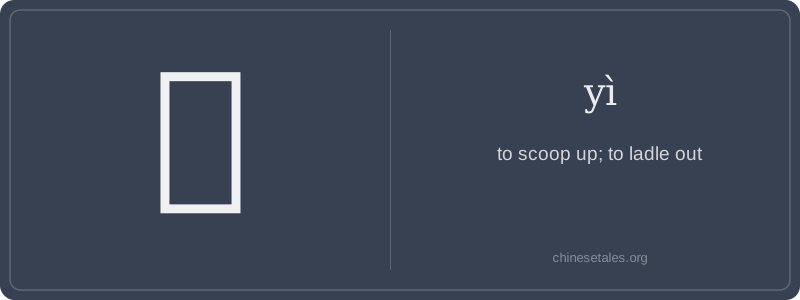
The earliest form of 挹 appears in Warring States bamboo slips as a hand (扌) reaching toward a curved vessel (represented by the right side, later evolving into 翊). That right-hand component wasn’t originally ‘wing’ — it mimicked the shape of an ancient bronze ladle: a shallow, concave scoop with a handle curving upward. Over centuries, the ladle shape stylized into 翊 (yì, meaning ‘to assist’ or ‘wings’), phonetically borrowed for its sound, while the left 扌 (hand radical) anchored the action. Stroke-by-stroke, the ten strokes coalesced: three for the hand, then seven for the elegant, sweeping curve of the ladle-arm — each stroke echoing the wrist’s gentle arc during scooping.
This visual logic persisted into classical usage: in the Book of Rites, 挹 describes ceremonial wine-scooping before offering to ancestors — a gesture of reverence, not utility. By the Tang dynasty, poets like Li Bai used 挹 metaphorically: ‘挹银河之水’ (scooping water from the Milky Way) — transforming physical action into cosmic aspiration. The character never lost its upward vector: whether lifting water, wine, or wisdom, 挹 always implies drawing something valuable *up from a source*, making it one of Chinese’s most poetically charged verbs of elevation.
Imagine standing beside an ancient well, bamboo ladle in hand, scooping cool water upward — that’s the visceral, kinetic heart of 挹 (yì). It’s not just ‘to pour’ or ‘to drink’; it’s the deliberate, upward motion of lifting liquid *from below*: a scoop, a lift, a drawing forth. The character feels tactile and purposeful — like bending your arm, wrist turning, and pulling something precious upward. You’ll rarely hear it in daily spoken Mandarin (hence its absence from HSK), but it lives vividly in classical poetry, formal writing, and literary idioms where precision and elegance matter.
Grammatically, 挹 functions as a transitive verb, almost always followed by what’s being scooped (e.g., 挹水, 挹酒) — and crucially, it implies *control* and *intention*. Unlike generic verbs like 倒 (dào, to pour) or 喝 (hē, to drink), 挹 carries quiet dignity: you don’t ‘yì’ coffee from a mug at breakfast — but you might 挹清泉 in a Tang poem or 挹酒敬师 in a ritual context. Learners sometimes misread it as ‘to pour out’ (like 倒), but no — the motion is *upward*, *inward*, *reverent*. Confusing it with 倚 (yǐ, to lean) or 益 (yì, benefit) is common — both share the same sound and visual similarity, but none share its physical grammar.
Culturally, 挹 appears in refined contexts: tea ceremonies, wine rituals, and metaphors for drawing wisdom (e.g., 挹取古训 — 'scooping up ancient teachings'). Its rarity makes it a linguistic jewel — when used, it signals literary awareness. A classic mistake? Using it transitively without an object ('I yì' alone sounds incomplete and archaic); it demands *what* you’re scooping. Also, avoid overusing it in modern speech — it’ll sound like quoting Confucius at a pizza party.