拱
Character Story & Explanation
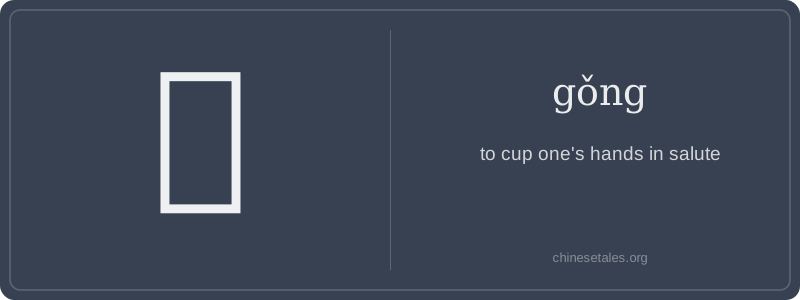
The earliest form of 拱 appears in bronze inscriptions (c. 1000 BCE) as a vivid pictograph: two stylized arms () framing a rounded shape (工), representing hands curving upward around an object — perhaps a ritual jade disc or a symbolic offering. Over time, the arms evolved into the 扌 (hand radical) on the left, while the right side simplified from 工 (gōng, 'work, craft') — not coincidentally echoing the modern pronunciation gǒng — retaining its sense of deliberate, skilled shaping. By the Han dynasty, the structure stabilized: nine strokes, with the three horizontal lines of 工 clearly visible beneath the sweeping diagonal of the hand radical.
This visual logic directly mirrors meaning: the hand radical signals bodily action; 工 evokes precision and ritual craftsmanship — fitting for a gesture refined over millennia in Confucian rites. In the *Analects*, Confucius praises those who 'bow without bending the back, salute without lifting the hands too high' — implicitly referencing the controlled elegance of 拱手. Even today, calligraphers note how the final stroke of 拱 sweeps upward like a rising palm — a subtle echo of that ancient, upward-cupping motion.
At its heart, 拱 (gǒng) is a gesture — not just any movement, but one charged with reverence, humility, and quiet intention. Picture two hands cupped together, palms up, elbows bent outward like gentle wings: that’s the visceral feeling of this character. It’s not a casual wave or a firm handshake; it’s the traditional Chinese salute — performed when greeting elders, honoring teachers, or paying respects at ancestral shrines. The action implies containment, offering, and upward lift — as if holding something precious (or invisible) between the palms.
Grammatically, 拗 is almost always used as a verb in formal or literary contexts, rarely in daily spoken Mandarin (where ‘wòshǒu’ or ‘dǎzhāohu’ dominate). You’ll see it in compound verbs like 拱手 (gǒng shǒu) — literally 'cup hands' — or in set phrases like 拱手相讓 (gǒng shǒu xiāng ràng), meaning 'to yield gracefully, as if offering with cupped hands.' Note: it’s *not* transitive — you don’t ‘拱 something’ — you simply 拱手 or 拱一拱 (gǒng yì gǒng), a soft reduplicated form implying modest, fleeting respect.
Culturally, learners often misread 拱 as passive or even submissive — but it’s actually deeply active: a conscious, embodied act of social calibration. A common mistake? Confusing it with 爆 (bào, 'to explode') due to similar stroke density — but where 爆 bursts outward, 拱 gathers inward. Also, never use it ironically or sarcastically in formal writing: this gesture carries centuries of ritual weight, and its tone is solemn, not playful.