拫
Character Story & Explanation
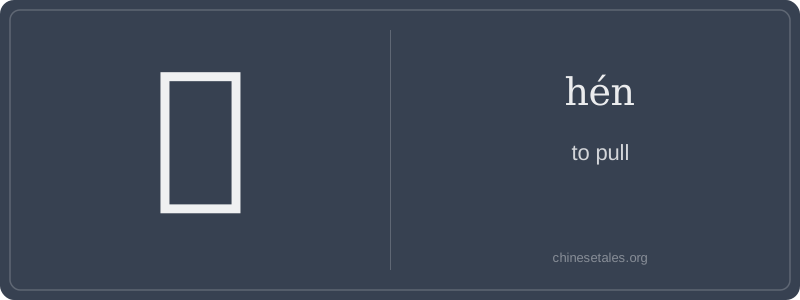
The earliest trace of 拫 appears not in oracle bones, but in late Warring States bronze inscriptions and early Han bamboo slips — and it’s a striking fusion. The left side 扌 (hand radical) is standard for hand-related actions, but the right side is the ancient form of 艮 (gèn), which originally depicted a person facing a mountain — symbolizing 'stopping' or 'firm resistance'. Combined, 扌+艮 visually suggests 'a hand exerting force against something immovable', hence 'to pull with effort' — not a gentle tug, but a determined, rooted extraction. Over centuries, 艮 simplified into the modern 亘-like shape we see today, losing its mountain contour but keeping its connotation of stubborn opposition.
This etymological tension shaped its literary life: in the Book of Rites (Lǐjì), 拫 appears in ritual descriptions of 'pulling up sacrificial stalks' — an act requiring both physical strength and symbolic severance. Later, in Tang poetry, it occasionally described pulling up weeds from ancestral graves, blending agrarian labor with filial duty. Its visual structure — hand confronting immovable force — became its semantic fingerprint: every use implied overcoming resistance. No wonder it faded from daily speech: modern life prefers efficient verbs, not philosophical tugs.
Let’s be honest: 拫 (hén) is a ghost character — it exists in dictionaries and classical texts, but you’ll almost never hear it spoken or see it written in modern Chinese. Its core meaning 'to pull' is real, but it’s been thoroughly eclipsed by far more common verbs like 拉 (lā), 拖 (tuō), and 扯 (chě). Think of it as the linguistic equivalent of a vintage typewriter key — functional in theory, but replaced decades ago. In classical usage, 拫 often appeared in formal or literary contexts describing forceful, deliberate pulling — like uprooting a tree or hauling a heavy cart — carrying a subtle sense of resistance or effort.
Grammatically, it behaves like a transitive verb (e.g., 拫树 — 'to pull up a tree'), but unlike 拉, it almost never appears in compound verbs, aspect particles (了, 过), or colloquial constructions. Learners who encounter it in an ancient text might mistakenly use it in speech — only to be met with polite confusion. It doesn’t take objects with 的, rarely pairs with direction complements (e.g., *拔回), and crucially, it has no common reduplicated or serial-verb forms. That’s not grammar pedantry — it’s evidence that 拫 isn’t just rare; it’s functionally dormant.
Culturally, its obscurity is telling: it survived in dictionaries thanks to textual preservation, not usage. Many native speakers have never seen it outside a dictionary or a Tang dynasty poem footnote. A common mistake is misreading it as 恨 (hèn, 'to hate') due to identical pronunciation in some dialects or sloppy handwriting — a hilarious but consequential mix-up ('I pull the bamboo' vs. 'I hate the bamboo'). So while 拫 teaches us about semantic precision in ancient Chinese, its real lesson is humility: language isn’t just about what’s possible — it’s about what people actually choose to say.