拗
Character Story & Explanation
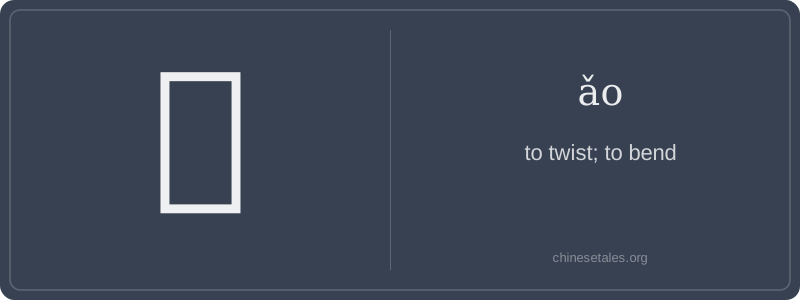
The earliest form of 拗 appears in bronze inscriptions as a hand radical (扌) gripping a bent, angular line — possibly representing a twisted stalk or stiffened reed. Over time, the right side evolved from a simple curved stroke into the modern '幼' component (yòu, 'young'), though this was purely phonetic — no semantic link to youth. The eight strokes solidified by the Han dynasty: three for the hand radical (扌), then five for 幼 — dot, horizontal, vertical, dot, hook — visually echoing the effort of gripping and twisting something rigid.
In classical texts, 拗 described both literal and metaphorical resistance: the Shuōwén Jiězì (2nd c. CE) defines it as 'breaking by twisting', and Tang poets used it to evoke nature’s quiet violence — bamboo stems snapping under snow load. Its visual duality is brilliant: the hand (扌) is active and deliberate, while 幼 (though silent here) hints at something small, fragile, yet unexpectedly hard to control — much like a child’s will, foreshadowing its later stubbornness meaning.
Think of 拗 (ǎo) as the Chinese equivalent of the English verb 'to wrench' — not just gentle bending, but a forceful, almost defiant twist, like snapping a dry twig or cranking a stubborn bolt. It’s visceral and physical: you *feel* the resistance in your forearm muscles when you say it. Unlike generic ‘bend’ verbs like 弯 (wān), 拗 implies struggle, tension, and often an irreversible change — imagine twisting wire until it kinks, not curving willow branches in the breeze.
Grammatically, it’s almost always transitive and action-oriented: you 拗 something — a metal rod, a branch, even a person’s will (in literary usage). It rarely appears alone; instead, it shows up in compounds (like 拗断 or 拗折) or in vivid descriptive phrases. Learners often mistakenly use it where 弯 or 折 would be more natural — e.g., saying '他拗腰' (he twists his waist) instead of '他弯腰' (he bends over). That sounds jarringly violent, like he’s cracking his spine!
Culturally, 拗 carries a subtle aura of obstinacy — its alternate pronunciations ào/niù (as in 执拗 zhí niù, 'stubborn') echo this sense of resistance. But crucially: those readings are *lexical*, not grammatical — you never say ǎo for 'stubborn'. Confusing the pronunciations is the #1 trap. Think of ǎo as the 'hands-on action' reading, while niù lives only in fixed words about unyielding character.