抦
Character Story & Explanation
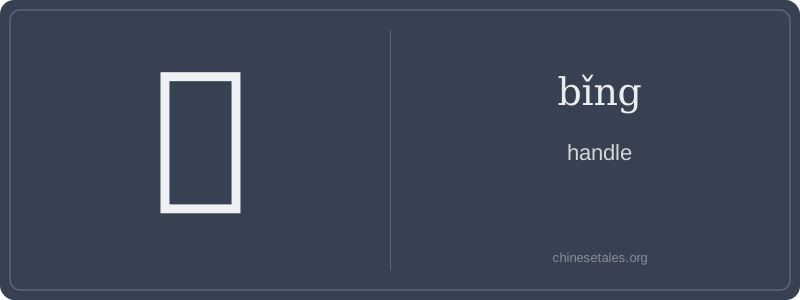
The earliest form of 抦 appears in bronze inscriptions of the Western Zhou dynasty (c. 1046–771 BCE) as a pictograph combining 手 (hand, later simplified to 扌) on the left and 丙 (bǐng, originally a pictograph of a candle stand or ritual vessel) on the right. The hand radical was unmistakable—a stylized arm and fingers—but 丙 wasn’t just phonetic; its shape resembled a stable, upright support structure, reinforcing the idea of ‘holding in position’ or ‘exercising controlled authority.’ Over centuries, the hand radical shrank into the modern 扌, while 丙 retained its core structure—two horizontal strokes bracketing a central vertical line, symbolizing balanced, deliberate control.
By the Han dynasty, 抦 had crystallized into its current form and meaning: not physical grasping, but authoritative management. In the Book of Rites (Lǐjì), it appears in phrases like 抦国 (bǐng guó, 'to govern the state'), where it conveys solemn stewardship rather than mere action. Its visual stability—the symmetrical, grounded 丙—mirrors its semantic weight: this is no impulsive act, but a measured, institutional gesture. Even today, when writers use 抦, they invoke that ancient resonance: the hand isn’t grabbing—it’s assuming duty.
Think of 抦 (bǐng) as the Chinese equivalent of the English word 'handle'—but not in the 'grab-and-lift' sense you’d use for a coffee mug. Instead, it’s the linguistic handle: the part of a compound word or phrase that you grasp to manipulate meaning, like twisting a dial to adjust nuance. It’s rarely used alone; instead, it appears almost exclusively in classical or literary compounds where it conveys control, management, or authoritative handling—think 'handling state affairs' or 'handling documents,' not 'handling chopsticks.'
Grammatically, 抦 functions as a verb (often in formal or bureaucratic contexts) and almost never as a noun. You won’t hear 'this is a good 抦'—it doesn’t mean 'a handle' as an object. Instead, it appears in verb-object constructions like 抦政 (bǐng zhèng, 'to administer government') or 抦笔 (bǐng bǐ, 'to take up the brush'—i.e., begin writing authoritatively). Learners mistakenly treat it like a modern, standalone verb (like 拿 ná), but 抦 carries gravitas—it implies responsibility, precedent, and institutional weight.
Culturally, 抦 evokes classical governance and scholarly authority. It’s the kind of character you’d find in imperial edicts or Confucian essays—not WeChat chats. A common error is confusing it with more colloquial verbs like 管 (guǎn) or 处理 (chǔlǐ); 抦 is narrower, more ceremonial, and almost always paired with high-register nouns (政, 笔, 权, 国). Its absence from HSK isn’t oversight—it’s exclusion by design: it’s too rare, too formal, and too steeped in pre-modern diction for beginner-to-intermediate learners.