抉
Character Story & Explanation
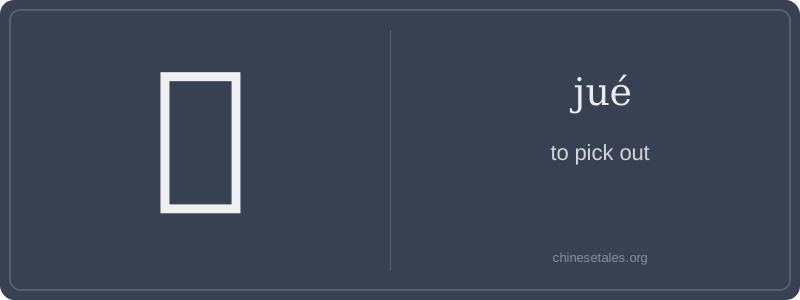
The earliest form of 抉 appears in Warring States bamboo texts, where it combined 手 (hand) on the left with 决 (jué, ‘to break open’) on the right — not the modern 乚 shape, but a clearer depiction of water breaking through a dam (冫+夬). Over centuries, 决 simplified: the ‘ice’ radical 冫 shrank, the ‘split’ component 夬 lost strokes, and the right side condensed into today’s 乚 — a subtle curve suggesting the *final flick* of a finger prying something loose. Meanwhile, 手 evolved into the standard hand radical 扌, anchoring the action firmly in physical dexterity.
This visual evolution mirrors its semantic journey: from concrete ‘prying open’ (e.g., digging out a thorn) in early texts like the *Zuo Zhuan*, to abstract ‘selecting after deep scrutiny’ by the Tang dynasty. The *Book of Rites* uses 抉 to describe selecting ritual jade — not just picking any piece, but *extracting the one flawless stone* from a rough pile. Even today, 抉 retains that sense of effortful discernment: you don’t ‘pick’ a career — you 抉择 it, as if sifting gold dust from river silt with your bare hands.
At its heart, 抉 (jué) is about *deliberate, often difficult selection* — not just 'picking' like 拿 (ná) or 取 (qǔ), but probing, prying, and extracting something specific from a mass or mess. Think of using tweezers to lift one splinter from deep in your palm: precise, intentional, sometimes painful. That tactile intensity is baked into the character — it’s never casual. You 抉择 (jué zé) a life path, 抉出 (jué chū) a hidden truth, or 抉剔 (jué tī) flaws in an argument. It almost always appears with another verb (like 出, 择, or 剔) or as part of a compound noun — you’ll rarely see it alone in modern speech.
Grammatically, 抉 is strictly transitive and almost never used without an object or complement. Learners often mistakenly treat it like a standalone verb meaning ‘to choose’ (e.g., *‘I 抉 this book’*), but that’s ungrammatical — it demands action: ‘I 抉出 this detail’, ‘She must 抉择 carefully’. It also carries subtle literary weight: using 抉 instead of 选 (xuǎn) signals gravity, introspection, or moral tension — like choosing between duty and desire in a classical novel.
Culturally, 抉 evokes Confucian self-cultivation: the careful, even painful, extraction of virtue from human weakness. A common mistake is overusing it in spoken Chinese — it sounds stiff or archaic outside formal writing or set phrases. Also, don’t confuse its radical 扌 (hand) with 忄 (heart) — this isn’t emotional preference; it’s *manual precision*. The sound jué rhymes with ‘jewel’ — fitting, since what you 抉 is often something precious, hidden, or hard-won.