抃
Character Story & Explanation
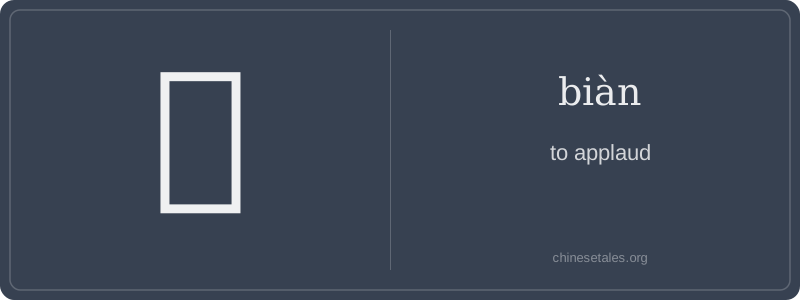
The earliest form of 抃 appears in Warring States bamboo slips as a hand radical (扌) gripping two parallel horizontal strokes — representing raised arms and open palms mid-clap. Over centuries, the two horizontals evolved into the top component 丐 (gài), which originally depicted a bent figure raising hands in supplication or celebration; by Han times, this was stylized into the current upper part, while the hand radical remained firmly anchored below, preserving the gesture’s physicality.
In the Book of Rites (Lǐjì), 抃 describes the ecstatic clapping of ministers upon hearing the Duke of Zhou’s virtuous edicts — a bodily affirmation of moral resonance. Later, in Tang poetry, Du Fu used it to evoke communal joy after drought-breaking rain: ‘百姓抃于野’ (the people clapped for joy in the fields). The character’s visual logic is elegant: 扌 (hand action) + 丐 (raised arms in open gesture) = the full-body, upward-sweeping motion of celebratory clapping — not just fingers snapping, but shoulders lifting, palms facing skyward.
Think of 抃 (biàn) as Chinese classical theater’s standing ovation — not the casual clap-clap-clap of modern life, but a full-bodied, rhythmic, almost ritualistic applause reserved for moments of profound joy or solemn celebration. It’s not used for everyday cheering (that’s 拍手 pāi shǒu); 抃 conveys exultation so intense it borders on ceremonial ecstasy — like ancient court musicians striking bronze bells in unison after a victorious campaign.
Grammatically, 抃 is almost always verb-only and appears in literary or formal contexts, often paired with classical particles like 而 (ér) or 以 (yǐ): ‘抃而舞之’ (clap and dance with joy). You’ll rarely see it alone — it thrives in four-character idioms or classical-style prose. Learners mistakenly try to use it like a transitive verb (‘I 抃 you’), but it’s intransitive and never takes an object: it’s about the *act* of clapping *as an expression*, not clapping *at someone*.
Culturally, 抃 carries Confucian weight — it signals harmony, collective joy aligned with virtue or cosmic order (e.g., ‘天下同抃’ — ‘all under heaven rejoice together’). Mistake it for 拍 or 鼓掌 and you’ll sound like a Ming-dynasty scholar accidentally quoting opera lyrics at a café. Its rarity today makes it a linguistic time capsule — spot it in a text, and you’re reading something deliberately elevated, poetic, or historically resonant.