扤
Character Story & Explanation
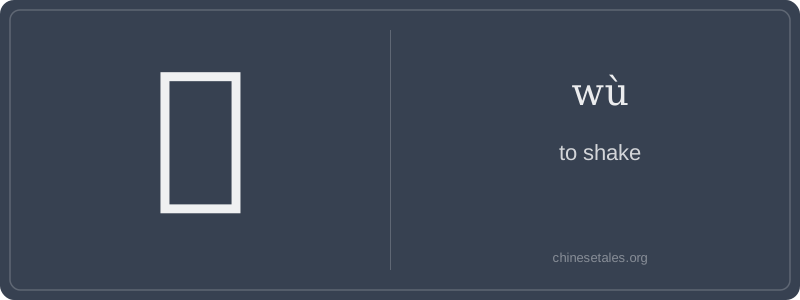
The earliest form of 扤 appears in bronze inscriptions as a combination of 手 (hand radical, later simplified to 扌) and 九 — but not the numeral 'nine'. In ancient script, 九 was a stylized depiction of a bent arm or coiling force, suggesting twisting motion. Over centuries, the right-hand component evolved from a sinuous, almost serpentine stroke into the modern 九, while the left side solidified into the hand radical 扌. Crucially, the original pictograph wasn’t about counting — it was about torque: one hand gripping, the other applying rotational pressure.
This visual logic anchored its meaning: not mere vibration, but purposeful, directional agitation. By the Han dynasty, 扤 appeared in texts like the *Shuōwén Jiězì* as 'to shake by pulling up and sideways', distinguishing it from downward presses or lateral pushes. In classical poetry, it described the trembling of banners before battle or the shuddering of ancient gates under siege — always implying tension, resistance, and imminent change. The character itself still 'twists' on the page: look closely — the 九 curves like a wrist turning hard against resistance.
At its heart, 扤 (wù) is a visceral, physical verb — not just 'to shake' in the abstract, but to jolt, wrench, or violently agitate something fixed or heavy. Think of gripping a stubborn door handle and giving it a sharp, upward twist; that’s 扤. It’s not gentle like 摇 (yáo) or rhythmic like 晃 (huàng). This character carries weight, resistance, and effort — you’re fighting inertia, not swaying with the breeze.
Grammatically, 扤 is almost always transitive and often appears in classical or literary contexts, rarely in daily spoken Mandarin. It commonly pairs with objects implying solidity or obstruction: 扤门 (wù mén, 'shake a heavy door'), 扤树 (wù shù, 'jerk a tree trunk'). You’ll rarely hear it in beginner dialogues — instead, it surfaces in historical novels, poetic descriptions of earthquakes, or idiomatic phrases like 扤动人心 (wù dòng rén xīn, 'to deeply stir people’s hearts'). Learners sometimes overuse it as a synonym for 'shake', missing its connotation of forceful, destabilizing motion — a subtle but crucial nuance.
Culturally, 扤 evokes classical imagery: the trembling of palace pillars during imperial edicts, or the earth heaving before calamity. Its rarity today makes it a linguistic time capsule — a word that feels more at home in Tang dynasty poetry than WeChat messages. Mistake alert: don’t confuse it with 悟 (wù, 'to realize') — same pinyin, completely unrelated meaning and origin. Pronunciation alone won’t save you here; context and character shape are your lifelines.