戳
Character Story & Explanation
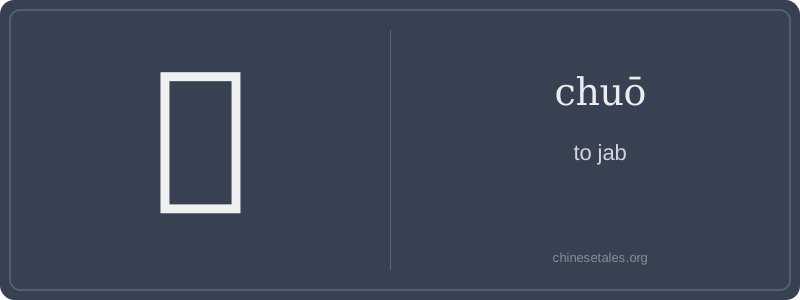
The earliest form of 戳 appears in Warring States bamboo texts as a composite ideograph: on the left, 戈 (gē), the ancient bronze dagger-axe — a weapon designed for thrusting and piercing; on the right, 虫 (chóng), originally depicting a coiled serpent or wriggling insect. This wasn’t literal entomology — 虫 here served phonetically (early pronunciations of 虫 and 戳 overlapped), but also evoked the *wriggling resistance* one feels when something sharp penetrates flesh or fabric. Over centuries, the right side evolved from a detailed虫 into the simplified 彐 + 乚 shape we see today — a stylized collapse of curves into angular strokes, while 戈 retained its unmistakable spearhead and shaft.
By the Han dynasty, 戳 had solidified as a verb meaning 'to stab, pierce, or puncture', appearing in medical texts describing acupuncture needles and military manuals noting how a poorly angled 戈-thrust could ‘fail to 戳 through armor’. Its semantic range expanded metaphorically during the Ming-Qing vernacular novels: in The Plum in the Golden Vase, characters ‘戳破虚伪’ (chuō pò xū wěi — ‘puncture hypocrisy’), showing how the physical act of piercing became inseparable from rhetorical exposure. Even today, the character’s visual tension — a rigid weapon meeting a squirming curve — mirrors its dual nature: blunt force meets subtle impact.
At its core, 戳 (chuō) is a sharp, sudden, and often slightly aggressive action — not just 'to poke' like 轻轻碰 (qīng qīng pèng), but to jab with intent: a finger into a sore spot, a pen into a document, or even a question that pierces through pretense. It carries physical immediacy and psychological force — think of the sting of an accusation or the precision of a bureaucratic stamp. Unlike gentle verbs like 点 (diǎn, 'to tap') or 摸 (mō, 'to touch'), 戳 implies penetration, pressure, and consequence.
Grammatically, 戳 is primarily a transitive verb requiring a direct object ('戳一下桌子' — 'jab the table once'), and it’s frequently used in colloquial imperatives or vivid descriptions ('他戳了戳屏幕,屏幕没反应' — 'He jabbed the screen — no response'). Learners often overuse it where 指 (zhǐ, 'to point') or 拍 (pāi, 'to tap') would be more natural; remember: if there’s no implied *penetration* or *sting*, you probably don’t need 戳. Also, it’s rarely used in formal writing — you’ll find it in dialogues, social media rants, or satirical essays, not government reports.
Culturally, 戳 thrives in expressive, slightly irreverent speech — it’s the verb behind internet slang like 戳中泪点 (chuō zhòng lèi diǎn, 'to hit an emotional soft spot') or 戳穿谎言 (chuō chuān huǎng yán, 'to puncture a lie'). A classic learner mistake is confusing it with the passive-voice marker 被 (bèi); they sound nothing alike, but the visual similarity of 戈 (gē, 'dagger-axe') radical can mislead beginners into thinking this character is about 'being attacked'. In fact, 戳 is always active — *you* do the jabbing.