戬
Character Story & Explanation
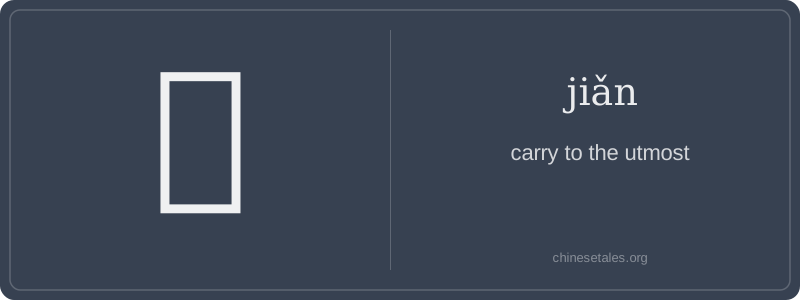
The earliest form of 戬 appears on Shang oracle bones as a composite glyph: a hand (又) gripping a halberd-like weapon (戈), with a small upward stroke above—suggesting motion *upward* along the shaft. By the Zhou bronze script, the hand evolved into a simplified ‘晋’-like upper component (later standardized as the top part of 戬), while the 戈 radical remained firmly anchored at the bottom, grounding the action in martial ritual. The 14 strokes crystallized during the Qin small seal script: 5 for the upper ‘晋’-derived element (representing ascent), 9 for the 戈 base (symbolizing the instrument of elevation). Every stroke reinforces verticality—no curves, no retreat, just upward thrust.
Its meaning grew from concrete ritual action to abstract moral perfection: in the *Book of Odes*, ‘戬’ appears in ‘戬穀’ (jiǎn gǔ), describing how sage-kings elevated benevolence (穀) to cosmic heights. Later, Han commentators linked it to ‘removing evil completely’—hence ‘戬除’. Crucially, the 戈 here isn’t about warfare; it’s the ceremonial *ge*, a symbol of authority used in rites of investiture. So 戬 isn’t ‘cutting with a spear’—it’s ‘raising virtue *with* the spear’, transforming a weapon into a liturgical staff. That semantic pivot—from tool to talisman—is what makes this character quietly revolutionary.
Imagine a Tang dynasty scholar kneeling before the emperor, holding a ceremonial halberd (戈) high above his head—not to strike, but to lift a sacred jade tablet *to its utmost height* as an act of supreme reverence. That’s 戬: not mere ‘carrying’, but carrying with total commitment, reaching the absolute peak of effort or virtue. In classical Chinese, 戬 functions almost exclusively as a literary verb meaning ‘to carry to the utmost’ or ‘to raise to the highest degree’—it’s never used casually. You’ll find it only in formal, poetic, or ritual contexts: ‘戬谷’ (jiǎn gǔ) means ‘to elevate auspiciousness to its pinnacle’; ‘戬除’ (jiǎn chú) means ‘to utterly eradicate’. It doesn’t take objects like modern verbs—it pairs with abstract nouns (virtue, calamity, blessings) and often appears in fixed two-character compounds.
Grammatically, 戬 is nearly extinct in spoken Mandarin and rarely stands alone. Learners who try to use it like a regular verb (e.g., *‘wǒ jiǎn le zhè ge shū’*) will sound comically archaic—or worse, nonsensical. It also has zero presence in HSK, textbooks, or daily apps, so encountering it usually means you’re reading pre-Qin bronze inscriptions or Song dynasty poetry. Its tone (jiǎn, third) rhymes with ‘jian’ in ‘Jian’ (as in ‘Jian Ghomeshi’), helping anchor pronunciation—but don’t confuse it with 剪 (jiǎn, ‘to cut’) or 简 (jiǎn, ‘simple’), which share the sound but none of the gravity.
Culturally, 戬 embodies Confucian idealism: the notion that moral action must be carried out *without reservation*, at full extension—like an arm raised not just high, but *to the limit*. Modern readers may misread it as ‘victory’ (due to the 戈 radical), but it’s actually about *ritual elevation*, not conquest. That subtlety is why even advanced learners often gloss over it—or worse, skip it entirely. Don’t. This character is a tiny time capsule of early Chinese cosmology, where gesture was ontology.