戌
Character Story & Explanation
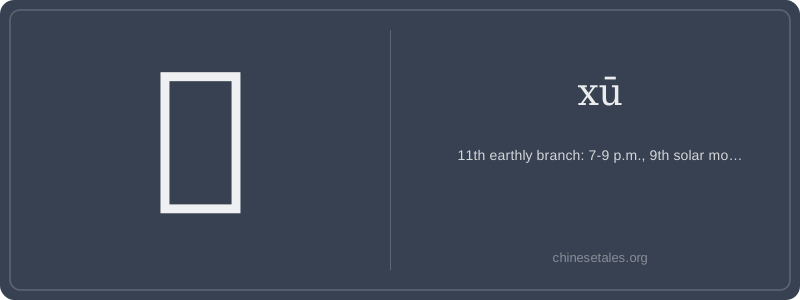
The earliest form of 戌, found on Shang dynasty oracle bones, was a vivid pictograph: a sharp-edged axe-head (戈 gē) mounted on a sturdy wooden haft, sometimes with added lines suggesting blade serrations or ritual notches. Over centuries, the haft simplified into a vertical stroke, the axe head evolved into the top-left ‘戊-like’ shape, and the diagonal hook (㇂) emerged — not as decoration, but as a stylized representation of the axe’s cutting edge in motion. By the Han dynasty clerical script, the six-stroke structure solidified: the radical 戈 (‘dagger-axe’) anchoring the character visually and semantically, reminding us this was originally a weapon of authority and seasonal boundary-marking.
This martial origin deeply shaped its meaning shift: in ancient Zhou rites, axes were wielded during autumn ceremonies to symbolize the ‘cutting away’ of summer’s excess — hence 戌’s link to the 9th lunar month and the Dog, an animal revered for guarding thresholds. The Classic of Changes (Yì Jīng) associates 戌 with ‘completion and readiness’, while Sima Qian’s Records of the Grand Historian uses 戌-time to mark imperial audiences — the hour when ministers ‘cut through’ trivialities to deliver urgent counsel. Visually, the character still carries that decisive, downward-sweeping energy: six strokes, no curves — all business, all boundary.
Think of 戌 (xū) as Chinese astrology’s ‘7–9 p.m. slot’ — like the British ‘tea time’ or New York’s ‘rush hour’: a culturally anchored, rhythmically precise time window that everyone *feels*, even if they don’t know the term. It’s not a standalone noun meaning ‘dog’ or ‘evening’; it’s one of twelve Earthly Branches — abstract temporal coordinates used in traditional calendars, fortune-telling, and classical texts. You’ll never say ‘I’m going to the 戌’ — but you *will* see it on temple plaques, birth charts (e.g., ‘born in the year of 丙戌’), or poetic references to autumn dusk.
Grammatically, 戌 almost never appears alone in modern speech or writing. It functions like a silent gear in a clockwork system: it combines with Heavenly Stems (e.g., 丙戌 bǐng xū) to form 60-year cycles, or pairs with other branches in phrases like 戌时 (xū shí, ‘the 7–9 p.m. hour’). Learners often mistakenly treat it as a common noun — but trying to use 戌 like ‘dog’ (e.g., ‘我家有戌’) is as off-key as saying ‘My birthday is in Gemini’ *without* the year or context. It only sings when paired.
Culturally, its Dog association isn’t about pets — it’s about loyalty, vigilance, and transition: the hour when day yields to night, and the ninth solar month (late September–mid-October) when harvest ends and winter looms. A frequent blunder? Confusing 戌 with 戊 (wù) or 戍 (shù) — three near-identical characters differing by *one tiny stroke*. That’s like mixing up ‘their’, ‘there’, and ‘they’re’ — harmless in English, catastrophic in classical timing or feng shui charts.