懵
Character Story & Explanation
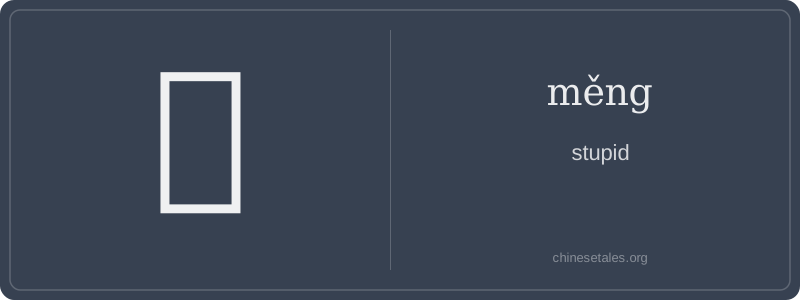
The earliest form of 懵 appears in late Warring States bamboo slips, where it combines 心 (xīn, heart/mind) on the left and a complex right-hand component derived from 蒙 (méng, to cover, obscure). That right side originally depicted a blindfolded person under a cloth — two eyes (目) beneath a covering (冡, an archaic form of 蒙). Over centuries, the blindfold simplified into the top 艹 (grass radical, here acting phonetically) and the covered eyes evolved into the lower part: ㄇ (a variant of 冂, symbolizing enclosure) plus 丶 (a dot representing obscured vision) and 一 (a horizontal bar sealing it all in). By the Han dynasty, it stabilized into today’s 18-stroke structure — a visual metaphor for the mind being literally *covered* and *blinded*.
This 'covered-mind' imagery persisted in classical usage: in the Tang dynasty poet Li He’s obscure verse, 懵 was used to describe the disoriented awe of mortals gazing at celestial phenomena — not ignorance, but sensory and intellectual overload. The character never meant 'foolish by nature'; rather, it captured the precise instant cognition collapses under novelty or complexity. Its modern colloquial explosion — especially in phrases like 懵圈儿 — honors that ancient core: not deficiency, but the humbling, universal shock of encountering the truly incomprehensible.
Think of 懵 (měng) as Chinese ‘deer-in-headlights’ — not clinical stupidity, but that stunned, wordless blankness when your brain hits a wall: a pop quiz you didn’t study for, a sudden tech failure, or someone dropping a philosophical bombshell mid-conversation. It’s less 'stupid' and more 'mentally unmoored' — a visceral state of cognitive paralysis. Unlike English 'stupid', which often implies low intelligence, 懵 is temporary, situational, and deeply empathetic: we say 懵了 (měng le) to confess our own momentary fog, never to insult others.
Grammatically, it’s almost always used in the reduplicated form 懵懵 or, far more commonly, as part of the perfective phrase 懵了 (měng le), meaning 'just became utterly baffled'. You’ll rarely see it alone as an adjective; instead, it lives in colloquial, spoken patterns like 我一下子懵了 (Wǒ yīxiàzi měng le — 'I totally zoned out in an instant') or 他听得懵了 (Tā tīng de měng le — 'He got so confused listening he shut down').
Culturally, this character carries zero moral judgment — it’s a shared human condition, even celebrated in internet slang like 懵圈儿 (měng quānr — 'spinning in confusion'). Learners often misread it as 'angry' (due to 忄) or force it into formal writing — but 懵 belongs to speech, memes, and self-deprecating honesty. Don’t use it in essays or resumes; save it for texting your friend after a mind-bending lecture.