懈
Character Story & Explanation
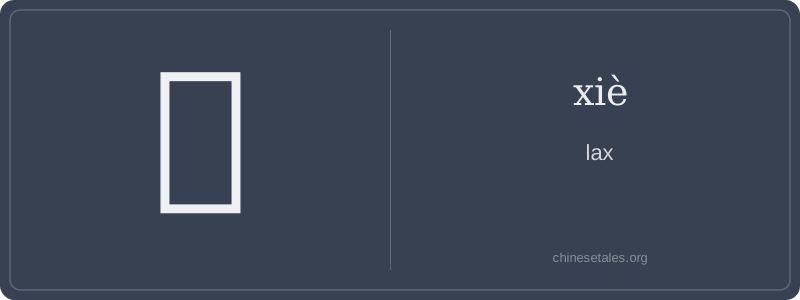
The earliest form of 懈 appears in seal script, built from 忄 (the ‘heart-mind’ radical) and 解 (jiě, ‘to untie, unravel’). Look closely: the right side 解 itself is a compound — 廌 (a mythical justice beast) + 刀 (knife) + 角 (horn), originally meaning ‘to untie a knot with precision’. When fused with 忄, it visually declares: ‘the heart-mind coming untied’ — not violently, but gradually, like a knot loosening under neglect. The 16 strokes map this tension: the three dots of 忄 pulse faintly; the complex 解 side sprawls with intersecting lines, mimicking fraying threads.
This ‘unraveling heart’ metaphor took root early. In the *Zuo Zhuan* (5th c. BCE), officials warned rulers against letting vigilance 懈 — lest chaos ‘unravel’ the state. By the Tang dynasty, poets used 懈 to describe spiritual lassitude in Buddhist meditation texts. Its visual logic held firm: the character doesn’t show collapse, but the *process* of undoing — making it uniquely precise among Chinese words for ‘laxity’. Even today, seeing those tangled strokes of 解 beside 忄 feels like watching resolve slowly come undone.
At its core, 懈 (xiè) isn’t just ‘lax’ — it’s the quiet erosion of will: that moment when your grip on discipline softens, your attention drifts, or your resolve frays at the edges. It carries a distinctly moral weight in Chinese, implying not mere carelessness but a failure of *xīn* (heart-mind), especially in contexts demanding perseverance — study, cultivation, duty. You’ll rarely hear it describing objects (‘a lax rope’); it’s almost always about human intentionality slipping.
Grammatically, 懈 is nearly always used in compounds or with negation. Standalone use is archaic; modern speech relies on phrases like 不懈 (bù xiè, ‘unremitting’) or 松懈 (sōng xiè, ‘to slack off’). It never takes aspect markers (了, 过) directly — you say 他松懈了 (tā sōng xiè le), not 他懈了. Learners often wrongly treat it as a verb like ‘relax’ and try to use it transitively; but 懈 is an intransitive stative verb — it describes a *state*, not an action you do *to* something.
Culturally, 懈 reveals how deeply Confucian ideals of self-cultivation are baked into the language: diligence isn’t optional — it’s the default posture of virtue. Mistaking 懈 for neutral ‘relaxed’ misses its subtle shame-adjacent tone. In classical texts like the *Book of Rites*, failing to guard against 懈 was equated with inviting moral collapse. Modern usage still echoes this — calling someone 懈 is a gentle but serious critique, like saying ‘you’ve let your standards drop’.