懅
Character Story & Explanation
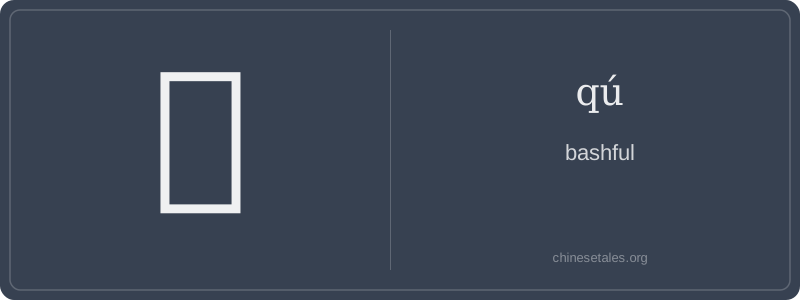
The earliest trace of 懅 appears not in oracle bones, but in Han dynasty clerical script — and its structure tells a vivid story. The left side 忄 (the 'heart-mind' radical) anchors it in emotion, while the right side 蕖 (qú) is a phonetic loan from the lotus plant 芙蕖 (fúqú). Wait — lotus? Yes! In ancient China, the lotus symbolized purity rising unstained from muddy water — and by extension, quiet integrity. Scribes borrowed 蕖’s sound *and* its cultural resonance: just as the lotus bows slightly but never breaks, the bashful person lowers their gaze without losing dignity. Over centuries, the character standardized into today’s form: three dots (heart), then the graceful, layered strokes of 蕖 — eight horizontal lines echoing lotus petals unfolding inward.
This semantic-phonetic marriage matured in Tang and Song poetry. Li Bai never used 懅, but Southern Song poet Yang Wanli did in a line describing a young scholar: '懅立风前,衣角微扬' ('Bashfully standing before the wind, his robe’s hem fluttering gently'). Notice how 懅 isn’t about inner turmoil — it’s posture, presence, restraint. Even today, calligraphers love writing it: the balanced asymmetry of 忄 + 蕖 mirrors the very quality it names — composed humility.
Think of 懅 (qú) as the quiet cousin of shyness — not the flustered, blushing kind you’d see in a rom-com, but a refined, almost poetic bashfulness: the gentle hesitation before speaking in front of elders, the soft downward glance when praised, or the delicate pause before accepting a gift. It’s not anxiety or fear — it’s *moral modesty*, rooted in Confucian ideals of humility and self-restraint. You’ll rarely hear it in casual speech; it lives in classical poetry, formal essays, and literary descriptions where emotional nuance matters more than speed.
Grammatically, 懅 is an adjective — but unlike modern adjectives like 害羞 (hàixiū), it doesn’t take 得 (de) for complements nor does it readily pair with 很 (hěn). Instead, it often appears in fixed literary patterns: 懅然 (qú rán, 'bashfully so'), 懅容 (qú róng, 'a bashful expression'), or as a standalone descriptive term after verbs like 露出 (lùchū, 'to reveal') or 浮现 (fúxiàn, 'to appear'). Trying to say 'I am qú' would sound archaic — native speakers use it to *paint* a mood, not declare a state.
Here’s the trap: learners sometimes confuse 懅 with 羞 (xiū) or 怯 (qiè) because they all relate to shyness — but 懅 carries no hint of weakness or inadequacy. It’s dignified, even elegant. And yes — it’s absent from HSK, textbooks, and most apps… which means encountering it feels like finding a secret bookmark in a Ming dynasty scroll. That’s why it’s worth learning: not for daily survival, but for reading the soul of classical Chinese sensibility.