憸
Character Story & Explanation
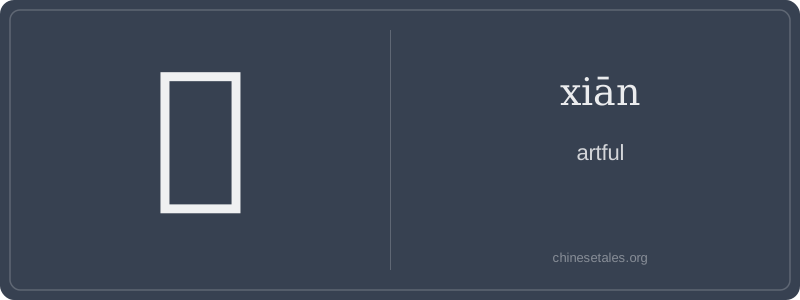
The earliest form of 憸 appears in bronze inscriptions from the late Zhou dynasty, where it was written with 心 (xīn, 'heart/mind') on the bottom and a variant of 先 (xiān, 'prior, elder') on top — not as a phonetic loan, but as a semantic compound: 'a mind that acts *before* principle, ahead of virtue'. The top component evolved from a pictograph of a foot stepping forward (the ancient form of 先), suggesting premature, self-serving action. Over centuries, the foot morphed into the modern 先 shape, while the heart radical solidified beneath — visually encoding the idea of intention (heart) moving ahead of ethics (propriety).
This visual logic shaped its meaning: by the Warring States period, 憸 specifically denoted those who mastered ritual forms and language *without* inner sincerity — the 'ritual technicians' Mencius warned against. In the *Zuo Zhuan*, 憸人 describes ministers who flatter rulers using impeccable classical diction while advancing private agendas. Its enduring power lies in this exactness: it doesn’t accuse of lying, but of *performing truth so well it hollows out truth itself*. Even today, when a critic writes that a politician’s speech is 'full of 憸巧', they’re not saying it’s deceptive — they’re saying it’s *too perfect*, too calibrated, and therefore spiritually empty.
Think of 憸 (xiān) as the Chinese equivalent of 'artful dodger' — not in the Dickensian sense of a charming thief, but as someone who navigates social or bureaucratic terrain with silky, almost imperceptible cunning. It doesn’t mean ‘clever’ like 聪明 (cōngmíng), nor ‘sly’ like 狡猾 (jiǎohuá); it’s more refined, even elegant — implying skillful manipulation masked by propriety. You’ll rarely hear it in casual speech; it lives in classical allusions, formal criticism, or literary descriptions of courtiers and scholars who wield influence through subtlety, not force.
Grammatically, 憸 functions almost exclusively as an adjective — always modifying nouns (e.g., 憸人, 憸巧), never used predicatively (*他很憸 is unnatural). It’s also strongly negative: calling someone 憸 is a quiet, devastating indictment — like saying someone is 'diplomatically corrosive' or 'ethically aerodynamic'. Learners often misapply it as a neutral synonym for 'skilled', missing its moral gravity. Also, beware: it’s never used in positive compounds like 'artful design' — 憸 is *always* about people, intentions, or methods that undermine integrity.
Culturally, 憸 carries Confucian weight: it names the precise flaw that undermines junzi (gentleman) virtue — not brute immorality, but the polished veneer of virtue hiding self-interest. In classical texts like the *Book of Documents*, 憸人 ('artful person') appears alongside terms like 邪僻 (xiépì, 'deviant') as warnings to rulers. Modern usage is rare and literary — you’ll find it in essays critiquing political rhetoric or historical novels depicting Ming dynasty intrigue. Mistaking it for a compliment is like praising a diplomat for being 'diplomatic' — technically true, but dangerously tone-deaf.