憯
Character Story & Explanation
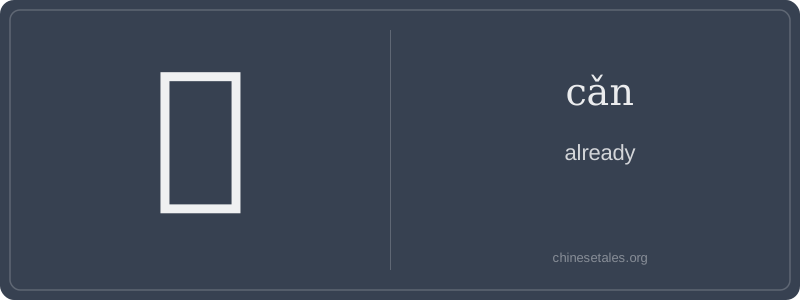
The earliest form of 憯 appears in bronze inscriptions of the Western Zhou, where it was written with a heart radical (忄) on the left and a complex right-hand component resembling ‘zàn’ (a ceremonial axe or chisel) — not the modern ‘can’ shape. That right side originally depicted a tool used in ritual carving, symbolizing *irrevocable action*: once carved into bronze, the inscription was permanent. Over centuries, the right side simplified and stylized — the ‘zàn’ element eroded into today’s ‘can’-like structure, while the heart radical stayed firm, anchoring its emotional weight.
This visual logic shaped its meaning: the heart + irreversible act = ‘already’ with psychological finality. By the Warring States period, 憯 appeared in texts like the *Zuo Zhuan*, marking moments where fate had irrevocably turned — e.g., ‘The prince 憯 dead’ meaning ‘was already, undeniably, beyond return.’ Unlike 已 (a simple ‘gone’ pictograph), 憯 embeds affect: it’s ‘already’ *felt*, not just noted. Its rarity today reflects how Chinese shed emotionally charged grammatical particles in favor of neutral ones — making 憯 a fossilized whisper of ancient rhetorical intensity.
Imagine you’re reading a Tang dynasty poem aloud, and suddenly hit this character: 憯. Your tongue stumbles — not because it’s hard to pronounce (cǎn, like 'tsan' with a falling tone), but because *nothing in modern Mandarin prepares you for it*. This isn’t ‘already’ as in ‘I’ve already eaten’ — that’s 已 (yǐ). 憯 is far older, rarer, and carries the hush of classical solemnity: it means ‘already’ *in the sense of irreversible completion*, often laced with sorrow or inevitability — like ‘the deed is already done, and there’s no turning back.’
Grammatically, 憯 functions as an adverb, typically placed before a verb or adjective in literary or poetic contexts — never in spoken Mandarin or beginner textbooks. You’ll find it in phrases like 憯不知 (cǎn bù zhī, ‘already unknowing’ — i.e., tragically unaware) or 憯已 (cǎn yǐ, ‘already indeed’ — emphasizing fatal finality). It never stands alone; it leans on other words for weight. Learners mistakenly use it like 已 or 已经, but doing so sounds like quoting Confucius at a Starbucks — jarringly archaic and slightly ominous.
Culturally, 憯 breathes the air of classical elegies and historical lamentations. It appears in the *Book of Songs* (Shījīng) and Han dynasty fu poetry, always paired with gravity: loss, betrayal, fate sealed. Modern readers rarely encounter it outside annotated classics or calligraphy scrolls — which is why it’s absent from HSK. The biggest trap? Assuming it’s a variant of 惨 (cǎn, ‘terrible’) — same sound, totally different soul. One evokes grief; the other evokes *already* — a quiet, chilling certainty.