憭
Character Story & Explanation
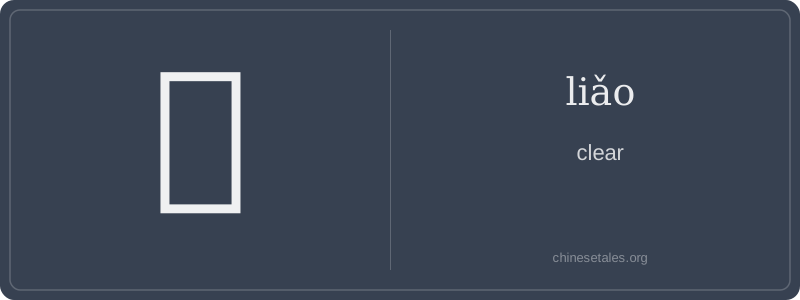
溯源而上, 憭 has no oracle bone or bronze script form — it’s a late-comer, born during the Han dynasty as a phonosemantic compound. Its left side, 忄 (the 'heart-mind' radical), signals emotional/cognitive resonance; its right side, 尞 (liǎo), is both sound clue and semantic echo — originally depicting a fire blazing high on an altar (燎), suggesting illumination rising from within. Over centuries, 尞 simplified, losing its fire dots and altar base, becoming a sleek, upward-reaching glyph — mirroring how clarity isn’t imposed, but rises organically from mental stillness.
By the Six Dynasties period, 憭 appeared in Buddhist sutras and Xuanxue ('Mystical Learning') commentaries to describe unobstructed awareness — the mind free of delusion, like a still lake reflecting the moon perfectly. The Tang poet Wang Wei used 憭明 to depict the silent clarity of mountain dawn — not brightness of light, but purity of perception. Visually, the three short strokes atop 尞 resemble flickering embers; the heart radical beneath grounds that light in feeling — a perfect visual metaphor: clarity isn’t cold logic, but warm, embodied knowing.
Let’s cut through the fog: 憭 (liǎo) means 'clear' — but not the kind you find on a weather app. Think *mental clarity*, *lucid insight*, or that 'aha!' moment when confusion lifts like morning mist. It’s deeply introspective, almost poetic — less about physical transparency and more about inner lucidity. You’ll rarely hear it in daily chat; it lives in classical allusions, literary descriptions, and refined expressions of perception.
Grammatically, 憭 is almost always an adjective, but it’s not used alone like 'clear' in English. It appears in fixed compounds (e.g., 憭憭 liǎo liǎo — 'crystal clear in mind') or as part of parallel, rhythmic phrases. You won’t say *'this idea is 憭'* — that sounds jarringly bare. Instead, it pairs with itself (憭憭) or with characters like 明 (as in 憭明) to create balanced, elegant emphasis. Learners often misapply it like a direct synonym for 清楚 (qīngchu), but that’s like swapping 'serene' for 'clean' — same root idea, wildly different register.
Culturally, 憭 carries quiet dignity — it’s the clarity of a sage, not a spreadsheet. It appears in Daoist texts describing unclouded awareness and in Tang poetry evoking still, luminous consciousness. A common mistake? Confusing it with 瞭 (liào, 'to look into') — they share the 'eye' radical but diverge completely: one peers outward, the other shines inward. Also beware tone slips: liǎo (third tone) ≠ liào (fourth tone) — mispronouncing it can make your 'clarity' sound like 'scouting'!