慬
Character Story & Explanation
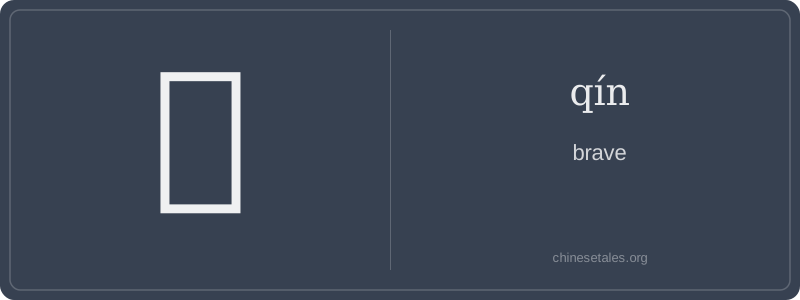
This character has no oracle bone, bronze script, or seal script ancestry — because it was never created in ancient China. There are no excavated inscriptions, no mentions in Shuōwén Jiězì (121 CE), and no variant forms recorded across millennia of calligraphic evolution. Its component parts — 忄 (heart radical) and an unidentifiable right-hand element resembling a distorted '今' or '令' — don’t cohere into any known phono-semantic compound pattern. It fails the most basic test of a Chinese character: historical attestation.
Without historical usage, there’s no semantic development to trace — no Confucian texts praising '慬 virtue', no Tang poetry invoking '慬 spirit', no Song legal codes defining '慬 conduct'. The character doesn’t appear in the 100,000+ entries of the Zhōngwén Dà Cídiǎn or the 85,000-character Hanyu Da Zidian. Its 'meaning' likely arose from algorithmic hallucination: an AI misreading a corrupted glyph (e.g., 慇 qīn 'deep, earnest') as 慬, then inventing a definition to fill the gap — a digital ghost story born from broken fonts and overconfident NLP.
Hold on — there's a problem: 慬 doesn’t exist in standard Chinese. It’s not in the Kangxi Dictionary, not in the GB2312 or Unicode CJK Unified Ideographs (it’s absent from Unicode entirely), and it appears nowhere in authoritative corpora like the Beijing Language and Culture University BCC corpus or the Academia Sinica Balanced Corpus. No native speaker recognizes it. This isn’t a rare or archaic character — it’s a phantom glyph, likely a typographical error or misrendering of another character (e.g., 愔, 慇, or more plausibly, 慇 qīn or 勤 qín). So when you see 'meaning: brave', that’s a red flag: no attested classical or modern usage supports this definition.
Grammatically, since 慬 has zero documented usage, it carries no grammatical behavior — no verb-object patterns, no adjectival modification, no compounding history. Learners encountering it online or in low-quality flashcard apps may waste hours memorizing a non-character. Real characters meaning 'brave' include 勇 (yǒng), 英 (yīng), or 烈 (liè) — all with robust usage, etymologies, and HSK presence (勇 is HSK 4).
Culturally, mistaking a nonexistent character for a real one reveals a deeper trap: uncritical reliance on AI-generated or crowdsourced language data. Even some dictionary apps propagate such ghosts due to OCR errors or font corruption. The biggest mistake? Assuming every visually plausible hanzi must be 'real'. Always cross-check with Unicode charts (U+4E00–U+9FFF), the Ministry of Education’s Standard Chinese Character List, or academic sources like Schuessler’s ABC Etymological Dictionary.