慝
Character Story & Explanation
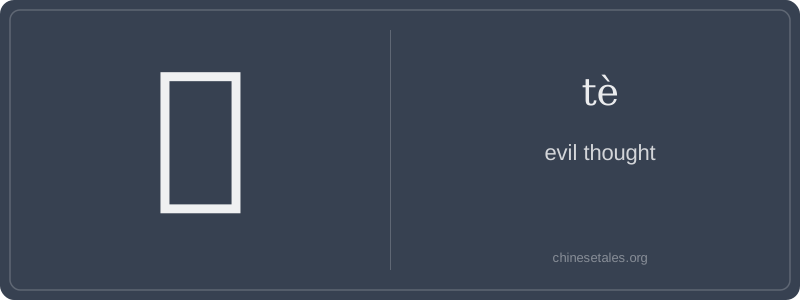
Oracle bone inscriptions show no direct precursor to 慝, but its bronze script form (c. 1000 BCE) already contained the 心 (heart/mind) radical at the bottom — signaling its domain was internal. The top part evolved from a phonetic component 勒 (lè, ‘to rein in’), which later simplified into the modern 特 (tè) shape — a visual pun: ‘a heart reined in’ or ‘a heart held back with force’. Over centuries, the strokes stabilized: the top ‘special’ (特) became stylized — two horizontal strokes, then the ‘deer antlers’ (厶) and ‘foot’ (攵) elements fused into a compact upper half, while the 心 remained unmistakably centered and grounded — literally anchoring the idea of buried intent.
This visual duality — ‘special restraint’ above, ‘heart’ below — mirrors its semantic evolution. In early texts like the *Zuo Zhuan*, 慝 referred specifically to concealed wrongdoing known only to the perpetrator, often tied to betrayal or usurpation. By the Han dynasty, it narrowed further: not just any hidden sin, but *malicious intention* that violates ritual propriety (礼). Its most famous appearance is in the *Book of Rites*: ‘君子戒慎乎其所不睹,恐惧乎其所不闻。莫见乎隐,莫显乎微,故君子慎其独也’ — where ‘hidden’ (隐) implies precisely this kind of 慝: the thought no one sees, yet morally decisive.
At its core, 慝 (tè) isn’t just ‘evil’ — it’s the quiet, internal kind: a sinister thought that hasn’t yet surfaced as action. In Chinese moral philosophy, especially Confucian and Daoist texts, the heart-mind (心) is where virtue and vice first stir; 慝 captures that precise moment when intention curdles — not rage or violence, but the cold, calculating flicker of malice *before* it speaks or strikes. It’s deeply psychological, almost clinical in its precision: you wouldn’t say someone ‘has 慝’ like a trait — rather, they ‘harbor 慝’ or ‘conceal 慝’, implying active suppression.
Grammatically, 慝 is almost never used alone. It appears only in classical or literary compounds — never in modern spoken Mandarin or HSK vocabulary. You’ll find it in set phrases like 隐慝 (yǐn tè, ‘hidden evil intent’) or 大慝 (dà tè, ‘grave moral transgression’), always as a noun, often modified by adjectives or verbs of concealment or revelation. Learners sometimes try to use it like 恶 (è, ‘evil’) — but that’s like using ‘malevolence’ instead of ‘bad’ in casual English: jarringly archaic and contextually wrong.
Culturally, 慝 reveals how Chinese ethics prioritizes *intention* over outcome — a concept echoed in the Analects (e.g., 2.18: ‘If one’s intentions are upright, even failure is virtuous’). Mistaking 慝 for a general ‘evil’ word leads to absurd translations: saying ‘he is 慝’ sounds like accusing someone of harboring premeditated treason in a Ming dynasty court document. Its rarity today makes it a linguistic fossil — beautiful, precise, and utterly unsuitable for ordering dumplings.