慁
Character Story & Explanation
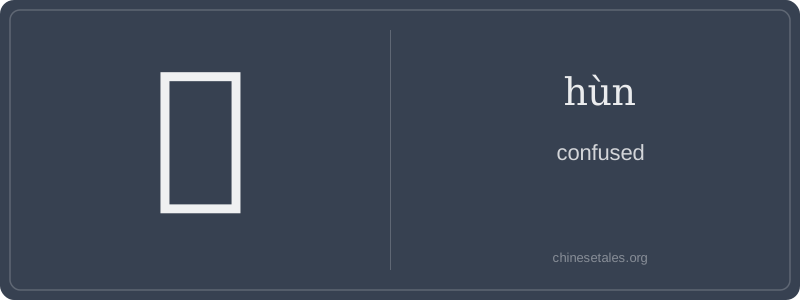
Trace back to its earliest form in bronze inscriptions (c. 1000 BCE), and 慁 began as a compound pictograph: on the left, 心 (xīn, 'heart/mind') — drawn as a stylized organ with chambers; on the right, 昏 (hūn, 'dusk, dimness') — originally showing the sun sinking behind a ground line. Together, they formed a vivid image: 'a mind veiled by twilight' — not darkness, but that hazy, uncertain moment when light fades and shapes blur. Over centuries, 昏 simplified: the sun (日) merged with the ground (氐-like element), and the heart radical stabilized into its modern three-dot-and-hook shape.
This visual metaphor anchored its meaning for over two millennia. In the Zuo Zhuan and early Zhuangzi, 慁 appears in passages describing ministers torn between loyalty and justice — their hearts 'dimmed', not by ignorance, but by irreconcilable duties. The character never meant 'stupid' or 'lost'; rather, it named the noble ache of conscience in ambiguity. Even today, its presence in classical poetry signals not confusion, but a refined, almost melancholic clarity about life’s unanswerable questions.
Let’s be honest: 慁 (hùn) is a quiet, almost ghostly character — it doesn’t shout, but it shivers with subtle unease. Its core meaning isn’t just ‘confused’ in the everyday sense (like 乱 or 迷糊), but a deeper, more literary disorientation — the kind that comes from moral uncertainty, social ambiguity, or intellectual entanglement. Think of standing at a crossroads where all paths seem equally valid *and* equally dangerous. That’s 慁: not panic, but profound, weighty perplexity.
Grammatically, it’s almost always an adjective — and rarely stands alone. You’ll see it in classical or formal written Chinese, often paired with 心 (xīn, 'heart/mind') as 慁心 (hùn xīn), meaning 'mentally distressing' or 'perplexing to the heart'. It never takes aspect markers like 了 or 过, and you’ll almost never hear it in spoken Mandarin — it’s strictly a literary, introspective word. Learners sometimes mistakenly use it like 混 (hùn, 'to mix') or 混乱 (hùn luàn, 'chaotic'), but 慁 carries no connotation of messiness or noise — only inner turbulence.
Culturally, 慁 echoes Confucian and Daoist concerns about clarity of intention and sincerity of conduct. In classical texts, it describes the discomfort of acting without moral certainty — a feeling deeply respected, even honored, as evidence of ethical self-awareness. A common mistake? Assuming it’s interchangeable with 困惑 (kùn huò, 'puzzled'). But while 困惑 is neutral curiosity, 慁 implies emotional cost — like your conscience is gently tugging your sleeve.