恺
Character Story & Explanation
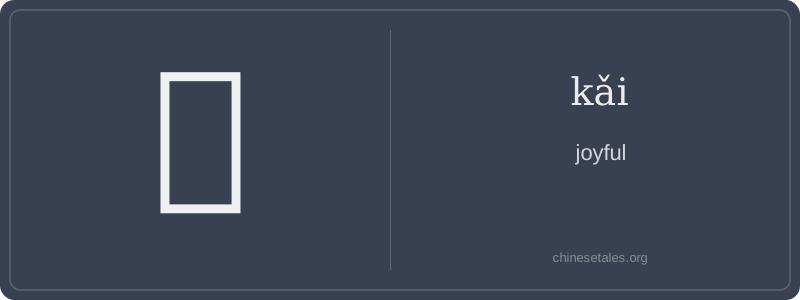
The earliest form of 恺 appears in Warring States bamboo slips as 忄+豈—a heart radical paired with 豈 (qǐ), originally a pictograph of a *covered vessel* (like a ceremonial wine jar) with a lid slightly ajar, suggesting something auspicious emerging. Over time, 豈 simplified from ⿱山几 to ⿱岂几, and the left side standardized into the three-stroke 忄 (heart) radical. Crucially, the top of 豈 was never ‘mountain’ (山) here—it’s a stylized lid, making 恺 literally ‘heart + auspicious emergence’—joy welling up naturally, like wine rising in a ritual vessel.
This visual metaphor anchored its meaning: not forced mirth, but effortless, virtuous delight. By the Han dynasty, 恺 appears in texts like the Shuōwén Jiězì defined as ‘joyful and gentle’ (喜乐也), and later became inseparable from Confucian ideals of humane leadership. The character’s elegance—its balanced nine strokes, flowing yet grounded—mirrors its semantic core: joy that is neither exuberant nor passive, but quietly sovereign, like sunlight falling evenly across a tranquil courtyard.
At its heart, 恺 (kǎi) is the quiet sparkle of genuine joy—not the explosive cheer of 喜 (xǐ), but the warm, steady glow of contentment and benevolent ease. Think of a scholar smiling faintly after resolving a philosophical puzzle, or a parent watching a child nap peacefully: it’s inner harmony made visible. This isn’t a casual ‘happy’—it’s literary, refined, and deeply rooted in classical ideals of virtuous serenity.
Grammatically, 恺 almost never stands alone in modern speech; you won’t hear someone say ‘我恺!’ It lives in elegant compounds like 恺悌 (kǎi tì)—a Confucian term meaning ‘gentle, kind, and approachable’—often describing exemplary rulers or elders. It also appears in names (e.g., 恺旋 kǎi xuán, ‘joyful turning’) and formal writing, where it conveys dignified cheerfulness. Learners mistakenly treat it like a synonym for 快乐 (kuàilè), but using 恺 alone sounds archaic or poetic—like saying ‘verily’ instead of ‘yes’ in English.
Culturally, 恺 carries the weight of early Chinese ethics: joy that arises from moral integrity and harmonious relationships, not external fortune. In the Book of Rites, 恺悌 is paired with ‘温良’ (wēn liáng, ‘gentleness and goodness’) as a hallmark of the cultivated person. A common slip is misreading it as 凯 (kǎi, ‘triumphant victory’)—but while both share pronunciation, 恺 is inward and tender; 凯 is outward and martial. That tiny difference in the right-hand component—豈 vs. 几—changes everything.