愕
Character Story & Explanation
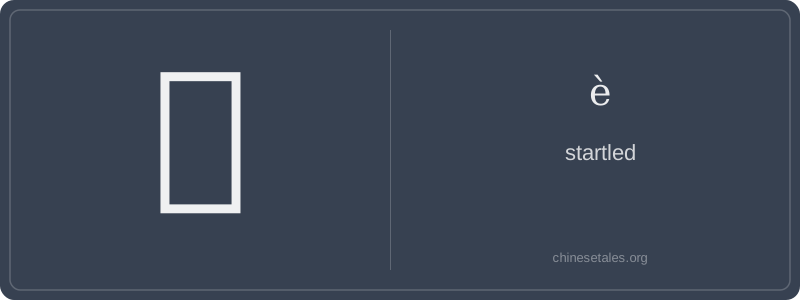
The earliest trace of 愕 appears in Warring States bamboo slips, not oracle bones — and it’s already recognizably modern. Its left side, 忄 (the ‘heart-mind’ radical), signals emotional resonance; the right side, 噩, was originally a double-mouth (口口) stacked over a dog (犬) — picturing a dog barking wildly at two mouths, evoking chaotic, jarring sound. Over centuries, the dog simplified into the top part of 噩 (the ‘four dots + cross’ shape), while the mouths fused into the lower ‘M’-like structure — giving us today’s elegant 12-stroke composition: 忄 + 噩.
This visual chaos directly birthed the meaning: sudden, disorienting surprise that disrupts inner calm. In the Shuōwén Jiězì (121 CE), Xu Shen defined it as ‘surprised appearance’ — capturing facial expression, not just feeling. By the Tang dynasty, poets used 愕然 to describe courtiers stunned by imperial edicts; in modern fiction, it’s the go-to for that split-second silence before a plot twist lands. The character’s power lies in its restraint: no shouting, no flailing — just stillness, wide-eyed and deeply human.
At its heart, 愕 is the sharp intake of breath — that frozen microsecond when reality glitches: your friend announces they’re moving to Antarctica, or you realize you’ve been speaking to a mannequin. It’s not panic (慌), nor fear (怕), but pure, unfiltered cognitive dissonance registered on the face — eyebrows lifted, mouth slightly open, eyes wide. In Chinese, it almost never stands alone; it lives in compound words like 惊愕 or 震愕, where it intensifies the ‘shock’ element with a quiet, dignified gravity.
Grammatically, 愕 functions as a noun or adjective within fixed phrases — you’d say ‘他露出惊愕的表情’ (He showed a startled expression), not ‘他愕’ (which sounds archaic and incomplete). Learners often misplace it trying to replicate English ‘I was astonished!’ — but 愕 doesn’t work in subject-predicate constructions like that. Instead, it’s embedded: ‘她愕然停住’ (She stopped, startled) — here 愕然 is an adverbial form, literally ‘startled-ly’, requiring the -然 suffix to function smoothly.
Culturally, 愕 carries a subtle literary elegance — it’s common in novels, news reports, and formal speech, but rare in casual texting or spoken slang (where 呆住 or 蒙了 dominate). A classic learner trap? Confusing it with 噩 (è, ‘nightmare’) — same pinyin, totally different radical and meaning. Also, don’t write it with 心 instead of 忄: the left-hand ‘heart-mind’ radical is non-negotiable — this emotion lives in the chest, not just the head.