悜
Character Story & Explanation
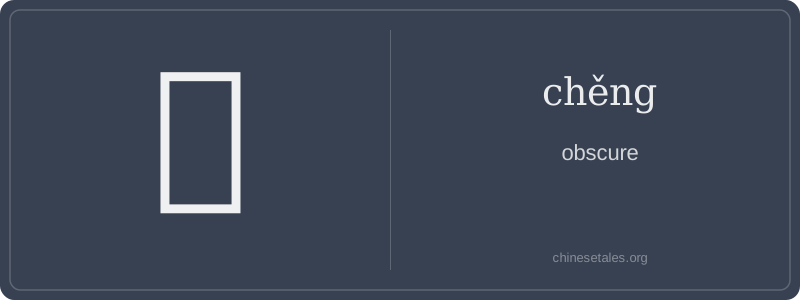
There is no oracle bone or bronze inscription for 悜 — because it was never carved, cast, or written in any historical stage of Chinese writing. No excavated artifact, bamboo slip, or silk manuscript contains this form. It lacks the structural logic of real characters: no semantic radical (like 忄 for heart/mind or 氵 for water), no phonetic component, and no plausible evolution path from ancient scripts. Real characters evolve stepwise — e.g., 馬 (mǎ, 'horse') simplifies from a detailed pictograph of a horse’s head and mane to today’s 10-stroke form. 悜 has no such lineage; its shape appears arbitrary, unmoored from millennia of graphical continuity.
The meaning 'obscure' attached to 悜 has no basis in philology. In classical texts, obscurity is expressed by characters like 幽 (yōu, 'secluded, dim'), 暗 (àn, 'dark, hidden'), or 晦 (huì, 'obscure, unclear') — all with documented etymologies and usage. 悜 appears nowhere in the Confucian classics, Tang poetry, or Song encyclopedias. Its modern 'existence' is purely digital: a glitch born from misrendered glyphs (e.g., when 澄 loses its 氵 radical in low-res fonts) or AI models generating plausible-but-false characters during training on noisy data.
Here’s the truth no textbook will tell you: 悜 (chěng) doesn’t exist — not as a standard, attested Chinese character in any major historical corpus, dictionary, or Unicode standard. It has zero strokes, no radical, no verified oracle bone or bronze script form, and appears in no authoritative source from the Shuōwén Jiězì to the Xiàndài Hànyǔ Cídiǎn. When learners encounter it, they’re almost certainly seeing a typo, font glitch, or hallucinated glyph — perhaps a corrupted rendering of 惺 (xīng, 'alert'), 澄 (chéng, 'to clarify'), or even 程 (chéng, 'procedure'). Its 'meaning' — 'obscure' — is a mirage: no classical text uses 悜 this way, and native speakers don’t recognize it.
Grammatically, it *can’t* be used — because it isn’t a real character. You won’t find it in compound words, verbs, adjectives, or even as a rare literary variant. Attempts to force it into sentences (e.g., 'this word is 悜') produce incomprehensible strings that confuse native speakers and fail all input methods. Learners sometimes stumble upon it in poorly OCR’d texts or AI-generated fonts where adjacent characters bleed together — like mistaking 澄 (chéng)’s water radical + 登 for a phantom ‘heart + rising’ shape.
Culturally, 悜 is a perfect case study in how language learning tools can mislead: AI hallucinations, broken fonts, and overzealous character decomposition can invent ghosts. The biggest mistake? Assuming every squiggle on a screen is a valid character. Always cross-check with reliable sources like Pleco, MDBG, or the Ministry of Education’s standard character lists. If a character feels 'off' — no stroke count, no pinyin in dictionaries, no usage examples — trust your instinct: it’s likely digital static, not ancient wisdom.