恞
Character Story & Explanation
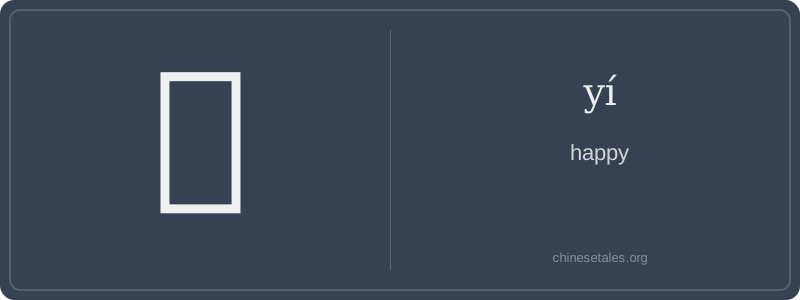
The earliest form of 恞 appears in Warring States bamboo slips (c. 475–221 BCE) as a compound glyph: the left side was 心 (xīn, ‘heart/mind’) — drawn as a stylized organ with three dots representing vital energy — and the right side was 台 (tái), which originally depicted a raised platform or terrace (in oracle bone script, it resembled stacked stones). Over centuries, 台 simplified into the modern 台 component, and 心 evolved into the radical 忄 (‘heart radical’) on the left — a subtle shift reflecting how emotional states were understood as internal landscapes built upon stable foundations.
This visual logic shaped its meaning: ‘a heart resting peacefully on a solid platform’ → inner calm grounded in harmony. In the Zhuangzi, the phrase 怡然自得 describes the sage who finds effortless joy in natural spontaneity; in Du Fu’s poetry, 怡色 (yí sè, ‘serene countenance’) signals moral composure under hardship. The character never meant fleeting delight — its stability was encoded in its very strokes. Even today, the two horizontal lines in 台 echo the idea of level ground, while the three dots of 心 remain — quiet pulses beneath stillness.
Here’s the truth no textbook tells you: 恞 (yí) doesn’t mean 'happy' in the cheerful, grinning sense — it means *serene, untroubled contentment*, the kind you feel watching mist rise off a still lake at dawn. It’s not about excitement or joy (that’s 快乐 kuàilè or 喜 xǐ), but about inner equilibrium, quiet ease, and gentle harmony — a deeply Daoist and Confucian ideal where happiness arises from alignment with nature and propriety, not external events.
Grammatically, 恞 is almost never used alone in modern speech; it’s a classical literary character that appears almost exclusively in fixed compounds (like 怡然 yírán or 怡悦 yíyuè) or poetic phrases. You won’t hear it in daily conversation — trying to say *‘I am 恞’* (wǒ hěn yí) would sound archaic or even comically stiff, like saying ‘I am e’en blithe’ in English. Instead, it functions as an elegant modifier: 怡然自得 (yírán zìdé) — ‘self-contentedly serene’ — paints a whole mood in four characters.
Learners often misread 恞 as ‘happy’ and force it into casual contexts, missing its profound cultural weight: it reflects China’s philosophical preference for calm sufficiency over exuberant emotion. Its rarity in spoken Mandarin also means it’s easily confused with similar-looking characters — especially when handwriting is messy. Remember: this isn’t a vocabulary word to use — it’s a lens into how Chinese tradition defines well-being as stillness, not sparkle.