恌
Character Story & Explanation
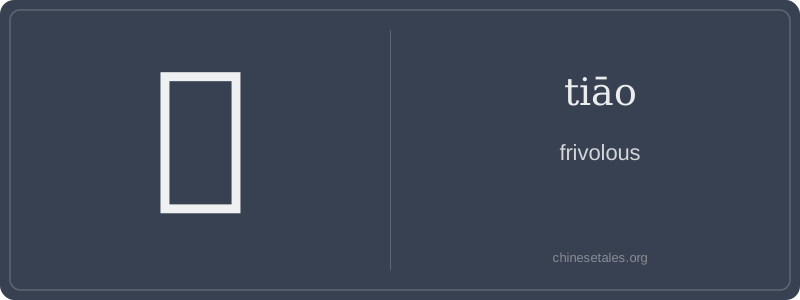
The earliest trace of 恌 appears not in oracle bone script, but in Warring States bronze inscriptions — where its left side was already the ‘heart-mind’ radical (忄), and the right side resembled a stylized ‘兆’ (zhào, ‘omen; portent’), drawn with three sharp, upward-flicking strokes suggesting instability, unpredictability, even auspicious chaos. Over centuries, ‘兆’ simplified into today’s form — but crucially, the heart-radical stayed anchored on the left, grounding the meaning in inner disposition, not outward action. By the Han dynasty, the character had stabilized into its current structure: two distinct semantic zones — emotion (忄) and volatile sign (兆) — fused into one ideograph.
This visual fusion shaped its meaning: 恌 doesn’t mean ‘silly’ or ‘childish’ — it means *a mind that treats omens lightly*, that dismisses portents with a smile. In the Book of Rites, it appears in critiques of musicians who ‘play with omen-signs’ — i.e., treat sacred ritual music as mere entertainment. Later, Su Shi used it to describe poets who ‘dance through taboo like butterflies over graves’. The character’s power lies in that tension: it looks calm (just 忄 + 兆), yet every stroke whispers, ‘This person does not take fate seriously.’
Think of 恌 (tiāo) as the linguistic equivalent of a raised eyebrow — it’s not outright rude, but it carries a quiet, knowing judgment about someone’s lightness of spirit. In classical Chinese, it describes behavior that’s playfully irreverent, flirtatiously careless, or charmingly undisciplined — never malicious, but always just a little too unmoored from solemnity. It’s an adjective, almost exclusively literary: you won’t hear it in casual speech or modern news headlines, but you’ll spot it in Tang poetry or Ming-dynasty essays describing a scholar who ‘laughs off ritual’ or a courtesan whose wit borders on impertinence.
Grammatically, 恌 behaves like other two-syllable adjectives in classical compounds — it rarely stands alone. You’ll see it in fixed four-character phrases (like 恌達不拘) or paired with characters like 達 (dá, ‘uninhibited’) or 戏 (xì, ‘playful’). Learners often misread it as ‘playful’ or ‘cheerful’ — but that’s dangerously incomplete: 恌 implies *moral or social levity*, not joy. Saying someone is 恌 is like calling them ‘flippant’ in English — it hints at a lack of gravitas, not a lack of fun.
Culturally, this character lives in the shadow of Confucian values: where seriousness (莊 zhuāng), reverence (敬 jìng), and restraint (慎 shèn) are virtues, 恌 names the subtle, aestheticized edge of their opposite. Modern learners sometimes overuse it trying to sound ‘literary’, but native speakers reserve it for precise, ironic, or historically tinted contexts — like quoting a 12th-century poet mocking courtly pretension. Mistake it for 調 (diào, ‘tone’) or 條 (tiáo, ‘item’), and you’ll accidentally write ‘frivolous tone’ or ‘frivolous item’ — which makes no sense and raises eyebrows far more than 恌 ever would.